

You lace your shoes, take a few steps, and feel a sharp ache across the top of your ankle or foot. It may appear after a run, a long shift, a change in footwear, or a simple misstep. Because the pain isn't on the familiar outside edge of the ankle, you may wonder whether it's a sprain, a tendon problem, a bone injury, or something being pinched.
The location matters. Ankle pain on top often involves structures that behave differently from the outer ankle ligaments. Tendons, small joints, bones, and nerve branches share a compact area, so the right treatment depends on identifying what is being overloaded or compressed. Canadian injury data also show that ankle and foot problems affect people across age groups, with youth aged 12–19 reporting a particularly high injury rate compared with adults and seniors (Statistics Canada data).
Why Top-of-Foot Pain Is Tricky to Diagnose
A recreational runner may finish a familiar route with pain “where the ankle meets the foot.” On examination, that description can shift from the front ankle crease to the middle of the foot. Tight laces may provoke it, stairs may sharpen it, and easy walking may feel fine until the toes push off.
The location alone does not identify the injured structure. The outside ankle has a recognizable rolling mechanism and familiar lateral ligaments. The dorsal region is more like a crowded intersection, where extensor tendons pass toward the toes, nerve branches travel close to the skin, and several small joints share movement and load. A similar point of pain can therefore reflect tendon overload, joint compression, or nerve irritation.

Location is your first useful clue
Pain that tracks in a narrow line toward the toes is more consistent with an extensor tendon. Deep discomfort in the front crease, especially when you pull the foot upward, raises the possibility of joint compression. A small, sharply localised tender spot over a bone deserves greater caution, particularly when walking or impact reliably reproduces the pain.
Burning, tingling, electric sensations, and numbness point toward nerve involvement. Footwear pressure, swelling, or nearby tissue can irritate a nerve even when the skin looks normal.
A minor-looking injury can still affect more than a ligament. A dorsal injury isn't automatically a harmless sprain, especially when pain persists, weight-bearing remains difficult, or the incident combined impact with twisting. The foot and ankle pain guide provides broader context, while the examination must identify the exact structure involved.
Why compression and overload matter
Dorsal pain often develops when repeated loading exceeds a tissue's current capacity, or when movement repeatedly narrows space around a joint or nerve. A new running schedule, hill work, stiff footwear, tight laces, or limited ankle motion can shift pressure toward the front of the foot. The same change can overload a tendon in one person and compress a nerve or joint in another.
As noted earlier, Canadian surveillance data place ankle and foot injuries in a substantial injury category. In the 2009–2010 Canadian Community Health Survey, Statistics Canada recorded 942,000 ankle and foot injuries among people aged 12 and older, a historical figure that illustrates how persistently this injury category recurs. It cannot identify the cause of an individual's dorsal pain, but it explains why careful location, symptom quality, and loading history matter.
The Four Main Culprits Behind Dorsal Pain
Pain on the top of the foot can begin after a clear injury, a change in training, or pressure from footwear. Four patterns commonly guide the clinical reasoning: extensor tendon overload, dorsal impingement, stress fracture, and nerve entrapment. They may overlap in location, but their triggers and symptom quality differ.
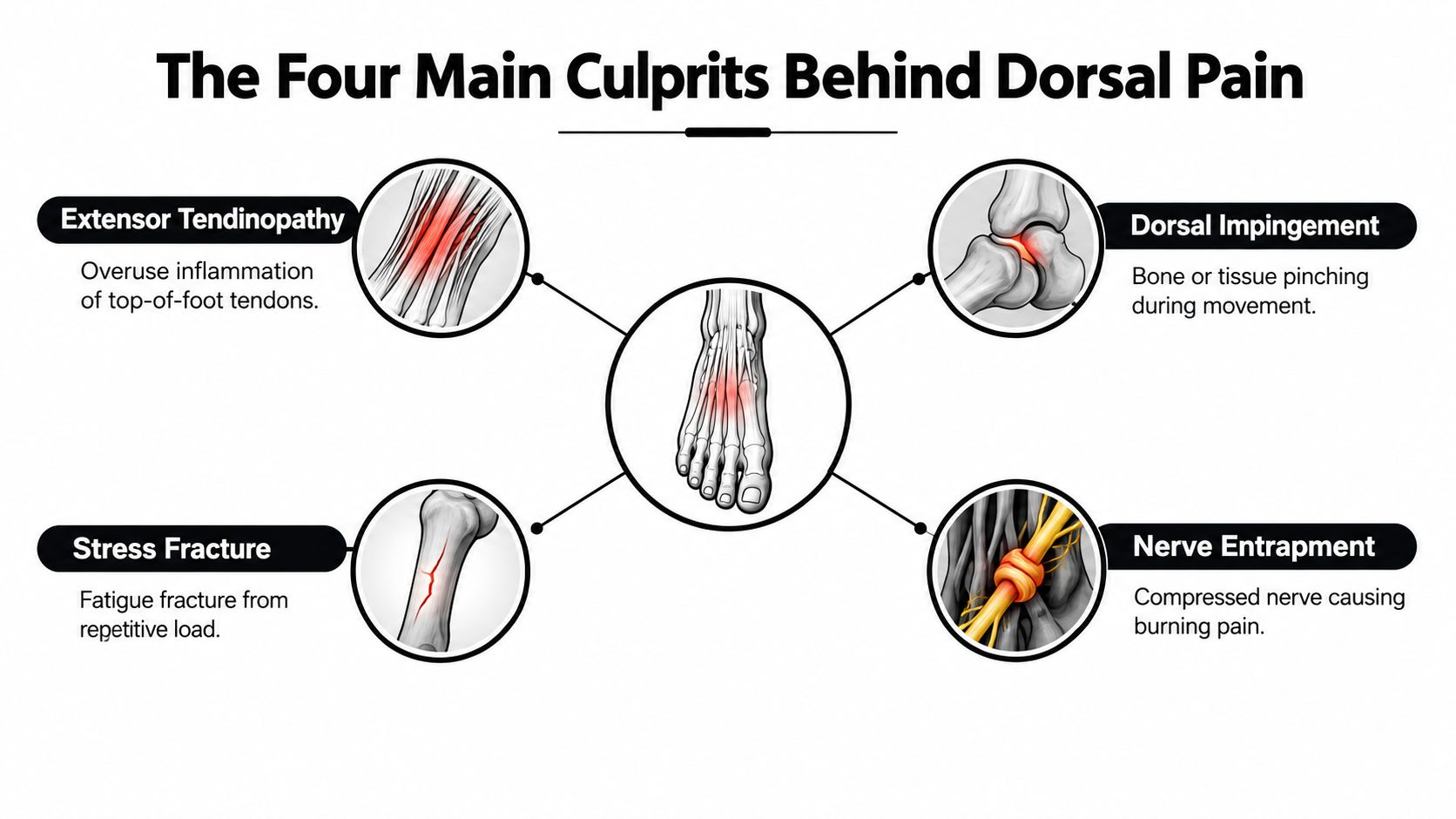
Extensor tendon overload
The extensor tendons cross the top of the foot and help lift the toes and foot. They work like tensioned ropes transmitting force from the lower leg to the toes. Repeated pulling can exceed the tendon's current capacity, leaving it painful and sensitive.
Extensor tendinopathy commonly causes tenderness along a line from the front of the ankle towards the toes. Symptoms may increase when you lift the toes against resistance, walk uphill, or raise your running volume. Tight laces can press directly on the tendons, so a previously manageable workload becomes painful.
The discomfort is often more superficial than joint pain. You may trace it with one finger, and gentle movement may feel easier than sudden, forceful toe lifting. This soft-tissue pattern differs from a focal bony injury. The discussion of pulling a foot muscle offers further context for recognising muscle and tendon overload.
Dorsal impingement
Dorsal impingement is a pinching problem at the front of the ankle or midfoot. The joint may move comfortably through part of its range, then produce a sharp, deep pain near the end of upward ankle movement. Squatting, stairs, sports positions, or repeated deep dorsiflexion can reproduce the symptom.
The pain usually sits in the front crease rather than along the tendon path. Changes around the joint, including swelling or altered movement mechanics, can reduce the available space. The result resembles a door catching against its frame, with symptoms appearing only when the joint reaches a particular position.
Stress fracture
A stress fracture is a fatigue injury in bone. Repeated loading creates a small area of damage faster than the bone can repair it. The pain is often focal, persistent, and increasingly reliable with impact.
One precise spot may hurt when pressed. Walking, hopping, running, or standing for long periods can increase the discomfort, which may not ease with gentle movement in the way tendon pain sometimes does. Continuing to load a stress injury can worsen it, so repeated home testing of focal bony pain is unhelpful.
Nerve entrapment
When footwear, swelling, or neighbouring tissue compresses a nerve, symptoms may include burning, pins and needles, altered sensation, or brief electric shocks across the top of the foot.
Nerve symptoms can spread towards the toes rather than remaining in one small area. They may fluctuate with shoe pressure or ankle position. Weakness, persistent numbness, or a noticeable sensory change warrants professional assessment instead of repeated stretching.
This video may help you visualise how foot and ankle structures contribute to movement, although it cannot replace an individual examination.
Assessment Cues and How to Identify the Cause
Self-screening can't confirm a diagnosis, but it can help you organise the symptoms before speaking with a clinician. Start with three questions: where is the pain, what movement reproduces it, and does the symptom feel like tissue pain or altered nerve sensation?
Use light pressure rather than aggressive testing. Compare the painful side with the other side, and stop if a manoeuvre creates severe pain, swelling, numbness, or a sense that something is being damaged.
| Condition | Primary Location | Aggravating Movement | Key Assessment Cue |
|---|---|---|---|
| Extensor tendon overload | A line across the top of the foot towards the toes | Lifting the toes or foot, uphill walking, repeated toe-off | Tenderness follows the tendon path and may respond to reduced shoe pressure |
| Dorsal impingement | Deep in the front ankle crease or upper midfoot | Pulling the foot upward, squatting, stairs | A sharp pinch appears near the end of the movement |
| Stress fracture | One precise area over a bone | Walking, running, hopping, direct pressure | Pain stays focal and doesn't reliably ease with gentle motion |
| Nerve entrapment | Top of the foot, sometimes extending towards the toes | Tight footwear or positions that increase pressure | Burning, tingling, electric pain, numbness, or altered sensation |
A careful home check
For suspected tendon involvement, gently lift your toes while using the other hand to provide mild resistance. Pain along the tendon path supports an overload pattern, but it doesn't prove tendinopathy. Don't repeat the test forcefully, because a painful tendon doesn't need a strength challenge to “prove” its problem.
For suspected impingement, perform a slow ankle bend with the heel supported. Notice whether discomfort appears only near the end of the upward movement and feels deep in the front crease. Compare that with pain that starts early and tracks towards the toes, which is more consistent with a tendon pathway.
Practical rule: A symptom that is focal, sharp, and consistently provoked by impact deserves more caution than a broad ache that settles with gentle movement.
Nerve symptoms need a different approach. Check whether loosening the laces changes the burning or tingling, and note any persistent numbness or weakness. Don't use aggressive massage over an area with reduced sensation, because you may not accurately judge pressure or irritation.
A broader explanation of front-of-ankle pain may be useful if your discomfort sits in the ankle crease rather than across the midfoot. Bring your observations to a physiotherapist, physician, or other qualified clinician, especially when the pattern doesn't settle quickly.
Conservative Care and Early Rehabilitation
The safest early plan is relative rest, not complete inactivity. Reduce the movement that provokes symptoms, but keep comfortable walking and gentle ankle motion if they don't increase pain during the activity or later that day.
If running causes symptoms, replace it temporarily with a lower-impact option only if the alternative is comfortable. A sore tendon may tolerate controlled movement, while a suspected bone injury needs a more cautious approach and clinical assessment.
Reduce pressure before adding exercise
Start by changing the environment around the painful area:
- Adjust the lacing: Skip the eyelets directly over the tender spot, or loosen the upper part of the shoe.
- Choose a stable fit: Use footwear that holds the heel without pressing hard across the ankle crease.
- Modify the route: Avoid hills, uneven surfaces, and high-impact sessions while they reproduce symptoms.
- Track the response: Judge the plan by how the foot feels later that day and the next morning, not only during the exercise.
You can also use gentle ankle circles and controlled foot movements within a comfortable range. The purpose is to maintain mobility without repeatedly forcing the painful structure into its most irritable position.
Build movement gradually
For a tendon-dominant presentation, try slow toe lifts without resistance, then progress to light resistance only when the movement is comfortable. Keep the ankle steady and avoid gripping with every toe. Controlled repetitions teach the tendon to accept load again, much like gradually increasing the weight carried by a rope.
For front-ankle stiffness, use a gentle knee-to-wall movement with the heel down. Move slowly, stop before a sharp pinch, and don't bounce. If the exercise produces a deep catching sensation rather than a mild stretch, reduce the range and seek an assessment.
A clinician-focused resource on rehabilitation assessment for clinicians can help professionals organise examination and progression decisions. For home advice after an injury, the guidance on ankle sprain home remedies may offer useful general measures, but neither resource can rule out a fracture or nerve problem in an individual case.
Use symptom relief as support
Cold application may ease soreness after activity, while comfortable warmth can help some people move more freely. Neither changes the underlying diagnosis. Topical options such as a cooling roll-on or an analgesic spray may provide temporary relief for sore muscle or joint areas, but use them as a supplement to load management, not as permission to train through worsening pain.
Progress only when walking is comfortable, swelling isn't increasing, and the next-day response remains stable. Pain that steadily becomes more focal or intense is a reason to reassess rather than add exercises.
When to Escalate and Specialist Care
Self-care is reasonable for mild, improving discomfort with a clear mechanical trigger. It becomes the wrong strategy when symptoms suggest fracture, significant compression, neurological involvement, or a problem that isn't responding to sensible load reduction.
The Ottawa Ankle Rules are used in Canada to help determine when imaging is needed after an acute ankle injury. BC Guidelines identify inability to bear weight for four steps, immediately after injury or during clinical assessment, and tenderness in specific bony zones as important fracture-screening findings (BC Guidelines). Dorsal pain after impact or inversion can involve an occult fracture or midfoot injury, so a negative early impression doesn't always end the assessment if pain persists.
Seek urgent help for disproportionate symptoms
Severe pain that seems out of proportion to the apparent injury is an emergency warning sign, particularly when swelling is tense or progressing. Pain with passive toe or ankle movement, pins and needles, weakness, or worsening colour and sensation also require urgent medical attention. Canadian chiropractic guidance identifies these features as concerning for acute compartment syndrome (Canadian Chiropractic Guidelines).
Don't massage aggressively, stretch forcefully, or continue testing the foot while those symptoms are developing. Arrange urgent assessment through appropriate medical services.
Arrange reassessment when recovery stalls
Persistent pain, recurrent swelling, repeated giving-way, or pain that returns whenever activity resumes deserves a structured evaluation. A sprain that never fully recovered may leave altered movement or instability, while persistent focal pain may require imaging to examine bone, cartilage, or tendon tissue.
Canadian sources also identify foot and ankle pain as a substantial musculoskeletal complaint. A British Columbia population survey reported foot or ankle pain or discomfort in 30.8% of respondents (Arthritis Research and Therapy). That prevalence doesn't make persistent pain harmless. It reinforces why a recurring symptom should be assessed rather than normalised.
If symptoms are worse at rest or at night, the discussion of sore ankles at night may help you prepare questions, but ongoing night pain still warrants clinical judgement. A physiotherapist, physician, podiatrist, or sports medicine clinician can decide whether radiographs, ultrasound, MRI, or another investigation is appropriate.
Moving Forward with Confidence
Top-of-foot pain becomes less mysterious when you separate tendon overload, joint compression, bone stress, and nerve irritation. The exact location, the movement that provokes it, and the quality of the sensation provide useful clues, but they don't replace an examination when pain is focal, severe, persistent, or associated with neurological changes.
Use relative rest to reduce aggravating load, adjust footwear and lacing, and restore movement gradually. Don't let temporary symptom relief hide a worsening pattern. A foot that feels better for an hour but hurts more after each walk needs a different plan.
Confidence returns when you know what your pain is responding to, and when you have a clear reason for each exercise.
The aim isn't to avoid movement indefinitely. It's to identify the painful structure, respect its current capacity, and build that capacity with controlled progression. If ankle pain on top keeps returning, accurate diagnosis is more useful than repeating generic rest.
MEDISTIK offers topical products, including sprays, sticks, and a cooling roll-on, for temporary relief of sore muscle and joint areas such as the ankle while you manage activity and rehabilitation. Visit MEDISTIK to explore the options and educational resources, then arrange a professional assessment if your symptoms persist or show any red flags.


