

You step off a curb, feel a sharp pull across the top or side of your foot, and sit down expecting the discomfort to settle. Instead, swelling appears, walking feels awkward, and you start wondering whether you've pulled a foot muscle, sprained a ligament, irritated a tendon, or fractured something. The safest response isn't to guess harder or push through. It's to protect the foot, identify warning signs, and progress from symptom control to movement, strength, and normal activity in stages.
Recognizing the Injury and Planning Your Recovery
A pulled foot muscle usually causes pain that increases when the affected muscle works or stretches. You may notice local tenderness, mild swelling, or a feeling of weakness during movements such as pushing off, lifting the toes, or turning the foot. The exact location matters. Pain over a joint, bruising after a twist, a snapping sensation, or marked difficulty bearing weight can point toward a ligament, tendon, or bone injury rather than an isolated muscle strain.
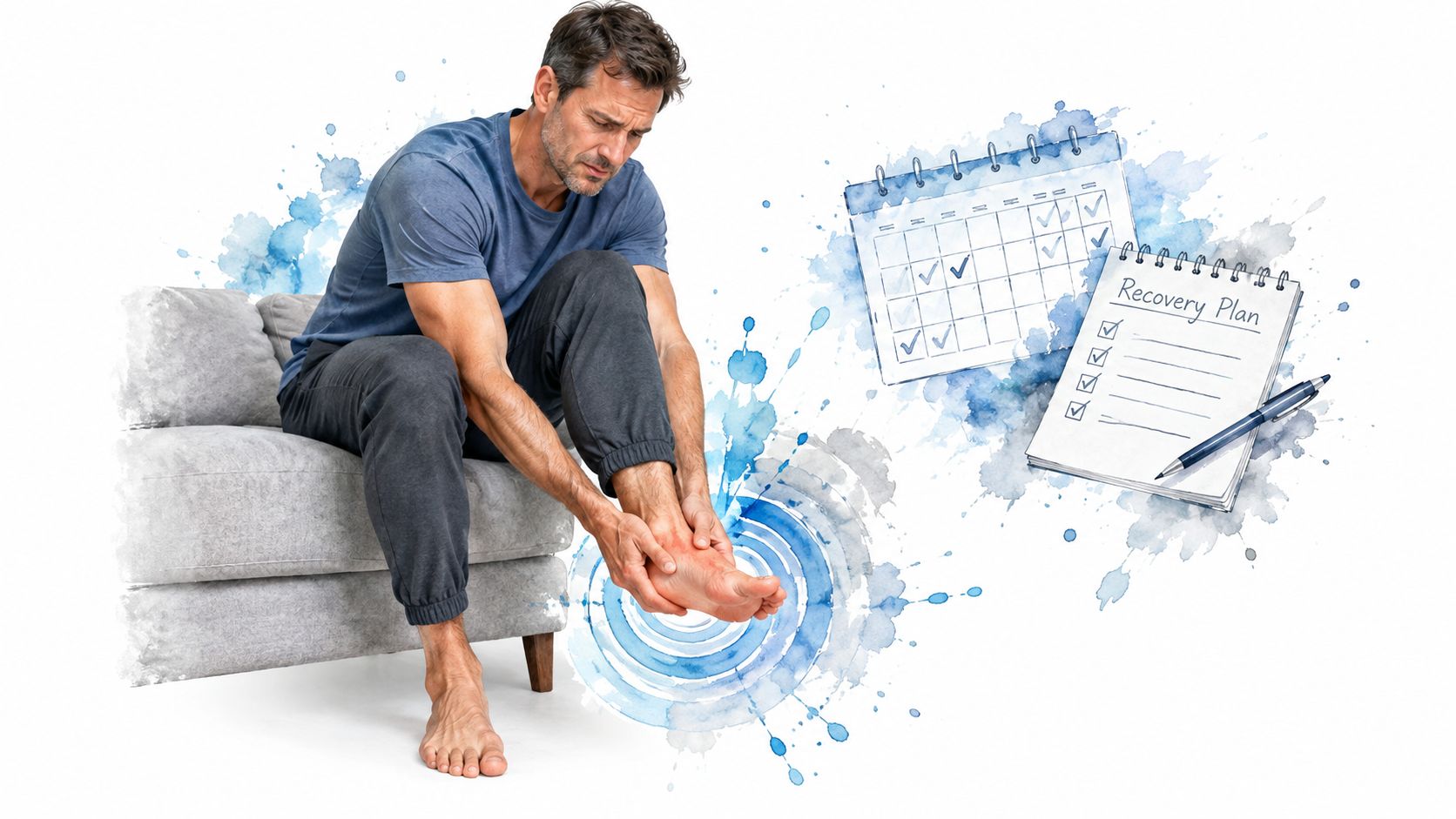
Canada's injury data explains why this distinction matters without making your symptoms unusual. Sprains and strains accounted for 42.7% of reported injuries in a national health survey, while the ankle and foot represented 22.2% of injured body parts. Females reported ankle and foot injuries more often than males in that dataset, 26.0% compared with 19.3% (Canadian injury data). These figures describe injury patterns, not your diagnosis, but they show how frequently the region is affected.
Match the plan to the symptom pattern
A minor strain often improves with protection and gradually restored movement. A ligament injury commonly follows a twist and may produce joint-line tenderness or instability. Tendon pain can be more focused along a tendon and may worsen repeatedly with resisted movement. A fracture becomes more concerning after significant trauma, substantial swelling, deformity, or an inability to use the foot.
A useful recovery sequence is simple:
- Protect the area while pain and swelling are active.
- Restore comfortable motion without forcing a stretch.
- Rebuild strength and control through light resistance.
- Increase walking, work, or sport demands only when the foot tolerates the current level.
For a broader explanation of the symptoms and recovery principles, see this guide to what a pulled muscle means. A staged approach usually works better than either extreme, rushing back immediately or keeping the foot completely still long after the acute irritation has settled.
Immediate First Aid Steps for a Pulled Foot Muscle
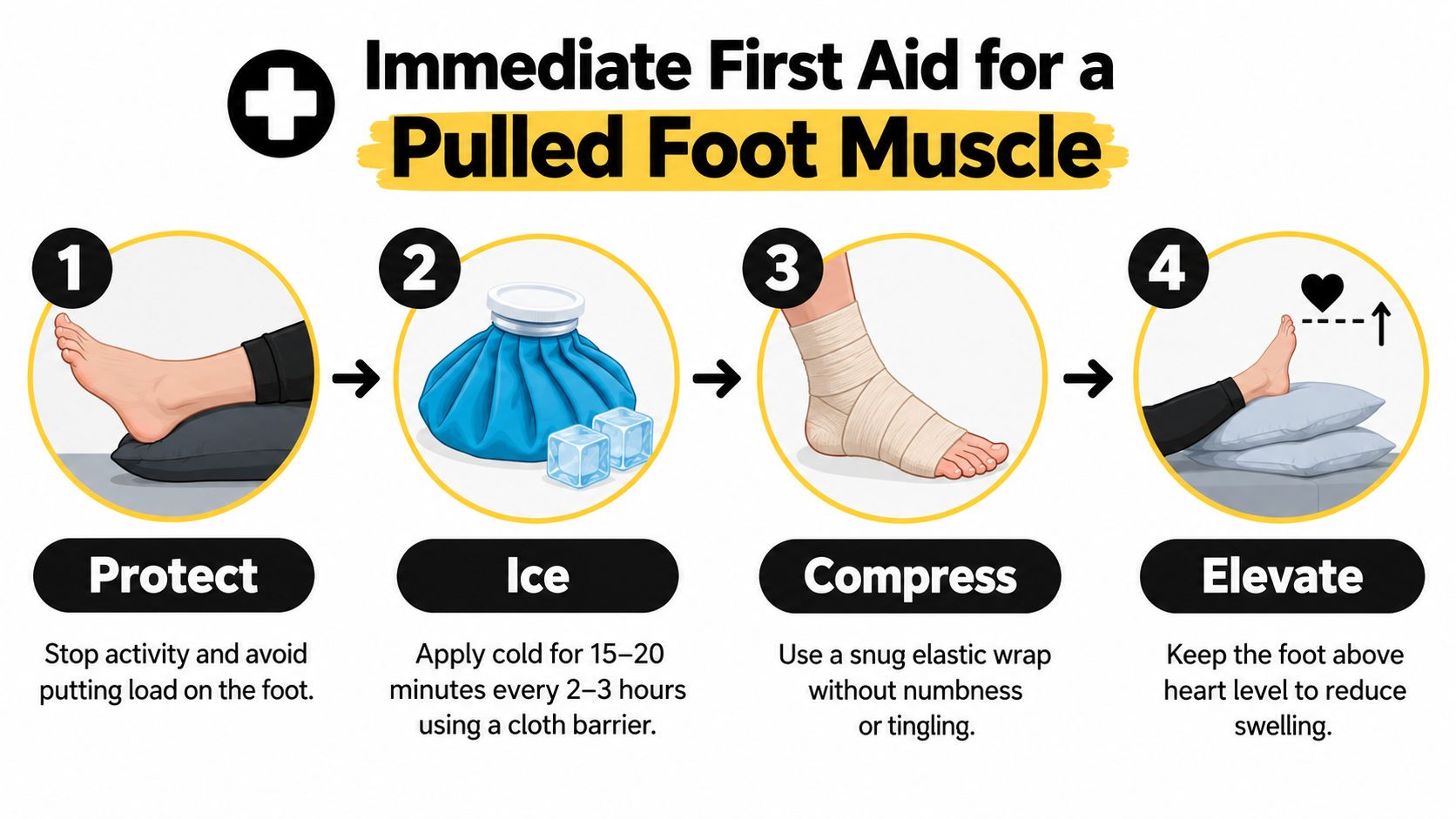
During the first few days, your priorities are protection, swelling control, and sensible loading. Stop the activity that caused the pain and avoid testing the foot repeatedly. If walking hurts, reduce weight-bearing. Alberta Health guidance recommends protecting the foot, using roomy footwear, and using crutches if they've been prescribed (Alberta aftercare guidance).
Use cold and elevation carefully
Apply a cold pack for 10 to 20 minutes at a time, with a thin cloth between the pack and your skin. For a muscle strain, Alberta guidance advises cold applications every 1 to 2 hours while awake during the first 3 days. Don't fall asleep with an ice pack on your foot, and stop if the skin becomes numb, unusually pale, or painful.
Raise the foot above heart level during the early swelling phase, particularly during the first 3 days. Elevation won't repair torn tissue, but it can make the foot feel less congested while you're resting. An elastic bandage may help if a healthcare professional has advised compression. It should feel supportive, never tight. Remove or loosen it if you develop tingling, numbness, colour change, or increased pain.
You can find practical guidance on choosing and using ice packs for ankle discomfort. The pack is a support tool, not a reason to keep the foot completely inactive.
Adjust the protocol as swelling settles
Alberta guidance allows heat after the initial phase, generally after 2 to 3 days, for 10 to 20 minutes several times a day, provided swelling is no longer increasing. Heat can make movement feel easier, but it isn't the right choice for a freshly swollen injury. Begin gentle exercises once pain and swelling have ended or clearly eased, and let the foot's response guide the next step.
For a visual demonstration of basic first aid principles, watch the following resource:
Pain Control Strategies and Topical Relief Options
Pain relief should help you move normally, sleep, and complete essential daily tasks. It shouldn't help you ignore a warning signal while sprinting, jumping, or working through a worsening injury. The purpose of symptom control is better movement, not permission to increase load before the tissue is ready.
Cold is most useful when swelling and heat dominate. Relative rest is appropriate when walking or a particular motion provokes symptoms, but complete inactivity can leave the foot stiff and deconditioned. Once the foot tolerates light movement, gentle mobility often becomes more useful than repeated passive treatments alone.
Compare the options by purpose
| Option | Best use | Main caution |
|---|---|---|
| Cold pack | Early swelling and irritability | Protect the skin and limit application time |
| Relative rest | Reducing aggravating load | Don't confuse it with prolonged immobilization |
| Gentle movement | Circulation and mobility | Stay below sharp or escalating pain |
| Topical analgesic | Temporary comfort during routine movement | Don't use relief to conceal serious symptoms |
A topical analgesic can be practical when the foot is difficult to reach with a cold pack or when you need temporary relief during a short walk, mobility session, or commute. MEDISTIK's non-prescription topical range includes a stick, spray, and roll-on format for temporary relief of sore muscles and joints associated with strains and sprains. Choose a format you can apply consistently, follow its label directions, and avoid applying it to broken or irritated skin.

If you're comparing topical approaches, this guide to CBD foot cream from HempWell USA offers another perspective on foot-focused topical products. It's still important to check ingredients, skin tolerance, and product directions rather than assuming every cream works in the same way.
The central trade-off is straightforward. A topical product may reduce the discomfort enough to allow a controlled exercise, but it doesn't establish that the strain has healed. If pain remains sharp, strength is declining, or swelling increases after activity, reduce the load and arrange an assessment. For Canadian product and topical pain-relief information, consult this topical pain relief guide.
Staged Exercises to Restore Mobility and Strength
Exercise should progress from motion to control to load. Start only when the foot can move without sharp pain and swelling is settling. The aim isn't to stretch aggressively. It's to restore normal movement while giving the tissues a manageable signal to adapt.
Begin with easy motion
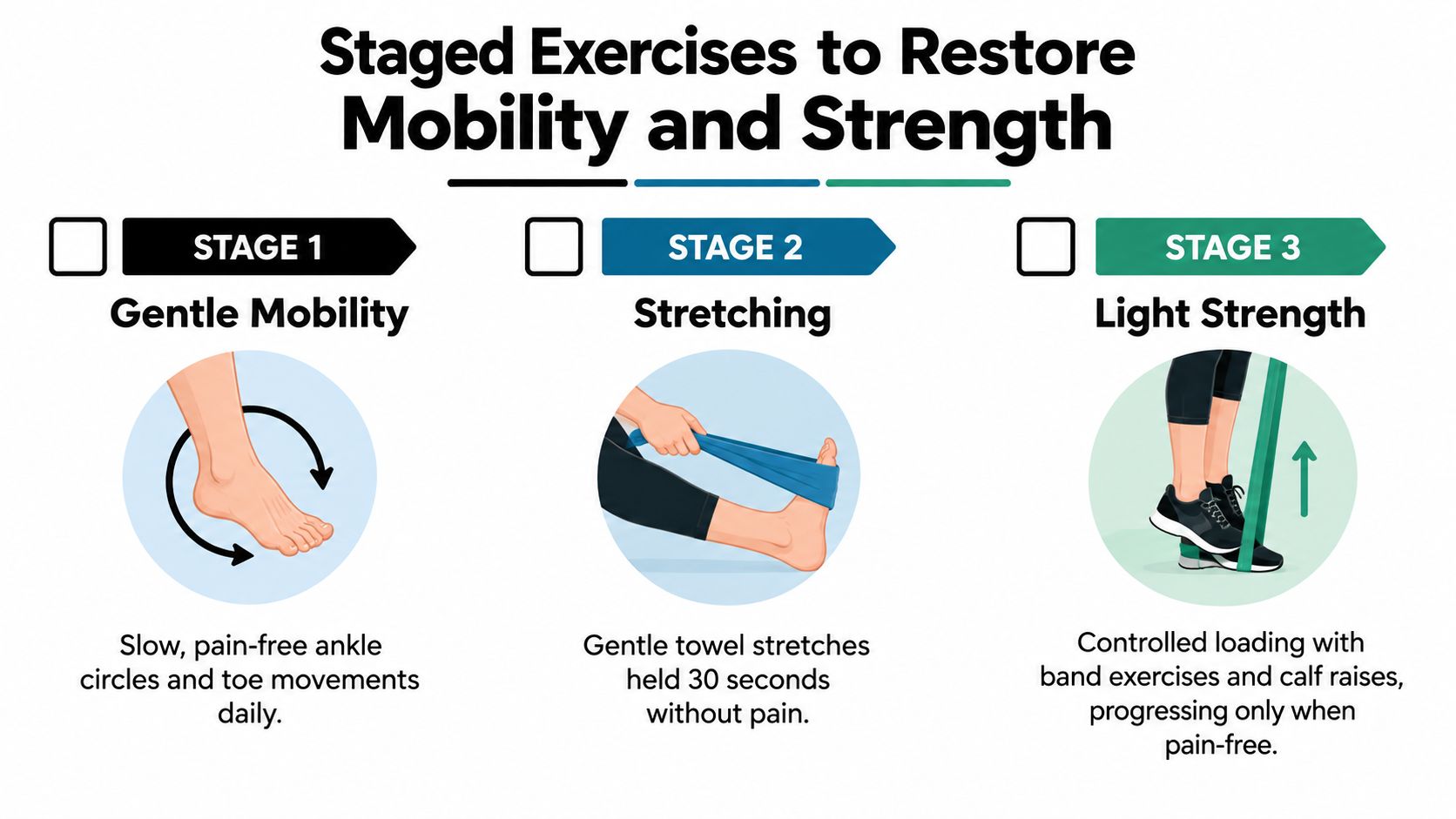
Sit with the leg supported and perform slow ankle circles within a comfortable range. Move the toes gently up and down, then practise spreading and relaxing them. These movements should feel easy, not forced. If the foot becomes more swollen later that day, reduce the range or frequency.
A towel-assisted calf stretch can follow once basic motion is comfortable. Keep the knee relaxed, draw the foot gently toward you, and stop before a sharp pull. Hold the stretch only as long as it remains comfortable. Stretching should restore tolerance, not create a second injury.
Add resistance when control returns
When walking is becoming easier and mobility no longer triggers a flare-up, introduce light resistance. A resistance band can support controlled movements into upward, downward, inward, and outward directions. Use slow repetitions and keep the foot aligned rather than allowing it to roll or twist.
Calf raises are a useful later progression if you can perform them without sharp pain or loss of control. Start with both feet and use support from a counter or chair. Progress toward greater loading only when the foot remains settled afterward.
Progression rule: If the next morning brings noticeably more pain, swelling, or stiffness, the previous session was too demanding.
Canadian rehabilitation guidance favours relative rest, meaning you avoid activities that provoke symptoms while maintaining tolerable physical activity (Ontario rehabilitation guidance). For more detail on pacing and expected recovery variables, read about muscle strain recovery time. Daily function is the test: controlled exercises should make ordinary walking and standing feel more secure, not less.
Why Foot and Ankle Strains Are So Common in Canada
Foot strains rarely happen in isolation from workload. A sudden change in running, repeated climbing, long shifts on hard flooring, uneven ground, or a quick pivot can ask more from the small muscles and tendons of the foot than they can currently tolerate. Cold weather can also change footwear choices and walking surfaces, but the key issue remains the relationship between tissue capacity and demand.
Canadian sport data shows why active people should take these injuries seriously without becoming fearful of movement. In a study of non-contact lower-limb injuries causing time loss from sport, muscle strain represented 8.5% of reported injuries, while the ankle was the most common injury location at 12.1% (Canadian sports-injury analysis). The same dataset found that 25.4% of athletes had at least one non-contact lower-limb injury during the previous 12 months.
Workload often explains recurrence
A person may feel better after resting but still lack the strength needed for a full shift, long hike, or rapid change of direction. Returning directly from minimal activity to the old workload creates a mismatch. The foot may tolerate walking on level ground but fail under sprinting, repeated stairs, carrying, or uneven terrain.
That's why “pulled foot muscle” deserves more than generic rest advice. The phrase may describe a true muscle strain, but it may also be a person's interpretation of pain from a ligament, tendon, or bone. Early protected movement helps minor soft-tissue injuries regain function, while careful symptom screening prevents a more serious problem from being treated as routine soreness.
A practical prevention strategy is to increase demanding activity gradually, keep warm-ups specific to the planned task, and continue strength work after symptoms disappear. Active adults, athletes, and physically demanding workers need a recovery plan that reflects what they do, not just whether they can take a few steps indoors.
Returning to Activity Safely After a Foot Strain
A calendar alone can't tell you when to resume activity. The better guide is capacity under gradually increasing demand. You should be able to bear weight comfortably, move the foot through a useful range, and complete light strengthening without a delayed increase in swelling or pain.
Use function-based checkpoints
For daily walking, begin with short, easy periods on level ground. Wear roomy, supportive footwear and avoid testing the foot with long errands immediately. If normal household movement remains comfortable afterward and the next morning, add time before adding speed or uneven terrain.
For work, match the progression to the physical task:
- Desk-based duties: Change position regularly and avoid keeping the foot dependent for long periods if swelling returns.
- Standing work: Alternate sitting and standing, use supportive footwear, and monitor swelling by the end of the shift.
- Manual work: Reintroduce lifting, stairs, ladders, and carrying separately rather than combining every demand at once.
- Sport: Restore walking, then brisk walking, then controlled sport-specific movements before fast changes of direction or jumping.
A return to training should include light resistance and controlled single-leg tasks when appropriate. You don't need to prove fitness by reproducing the original injury mechanism. You need to show that the foot can absorb the planned load repeatedly without losing control.
Let the response set the pace
Alberta guidance supports walking when it isn't painful, gentle rubbing if tolerated, and progressive movement and strengthening rather than automatic prolonged immobilization (Alberta activity guidance). That approach respects the difference between useful loading and irritating loading.
Pain during a movement is information. Pain that escalates, changes your gait, or remains worse afterward is a reason to reduce the dose.
If the foot handles the current level, progress one variable at a time, such as duration, speed, terrain, resistance, or frequency. If symptoms flare, return to the last comfortable level instead of abandoning movement completely. Athletes and workers should also consider whether the original workload changed abruptly, because correcting that trigger is part of preventing recurrence.
Common Mistakes and Red Flags to Watch For
The most common recovery errors are not complicated. People either keep using the foot as if nothing happened, or they protect it so completely that stiffness and weakness become additional problems. Others wrap compression too tightly, apply ice directly to the skin, or use pain relief to continue an activity that is clearly provoking symptoms.
Relative rest is the safer middle ground. Avoid the movement that causes pain, swelling, or limping, but keep comfortable motion elsewhere in the body and resume gentle foot movement when symptoms allow. Compression should support rather than squeeze. Footwear should give the toes and swollen areas enough room.
Know when self-care isn't enough
Seek prompt medical advice after major trauma, when you can't move the foot or toes, or when you can't bear weight appropriately. Increasing bruising, marked swelling, visible deformity, a snapping or popping sensation, or pronounced weakness also deserves assessment because these features can indicate a tendon, ligament, or bone problem rather than a minor strain.
Alberta's foot-injury guidance also treats symptoms that persist beyond 2 days as a reason to seek further advice, particularly when the diagnosis is uncertain (Alberta foot-injury guidance). Don't wait for self-care to fail completely if the foot is worsening or your walking pattern is becoming more abnormal.
For pain that seems out of proportion, keeps returning, or doesn't match a clear injury, review the warning signs in this guide to when to worry about leg pain. A clinician can examine the painful structures and decide whether imaging, support, or a supervised rehabilitation plan is appropriate.
A pulled foot muscle is best managed as a progression, not a single treatment. Protect the foot early, control swelling, use topical relief only as a support, restore motion, rebuild strength, and increase activity according to function. That approach keeps comfort and tissue recovery working together instead of allowing one to hide problems caused by the other.
MEDISTIK offers Canadian-made, non-prescription topical options in stick, spray, and roll-on formats for temporary relief of sore muscles and joints during recovery. Use symptom relief alongside staged movement, and visit MEDISTIK to explore products and practical pain-management resources for a pulled foot muscle.


