

You wake up with a sore calf and try to remember what you did yesterday. Was it the stairs, a workout, or just sleeping awkwardly? Then you notice that the other leg feels fine, and you wonder whether to stretch, wait, or call someone.
Knowing when to worry about calf pain depends less on how much it hurts than on the pattern: how it started, whether the leg looks different, and what else is happening in your body. A clinician makes the diagnosis, but you can use those clues to choose the right level of care.
Which Calf Pain Needs Urgent Care Today
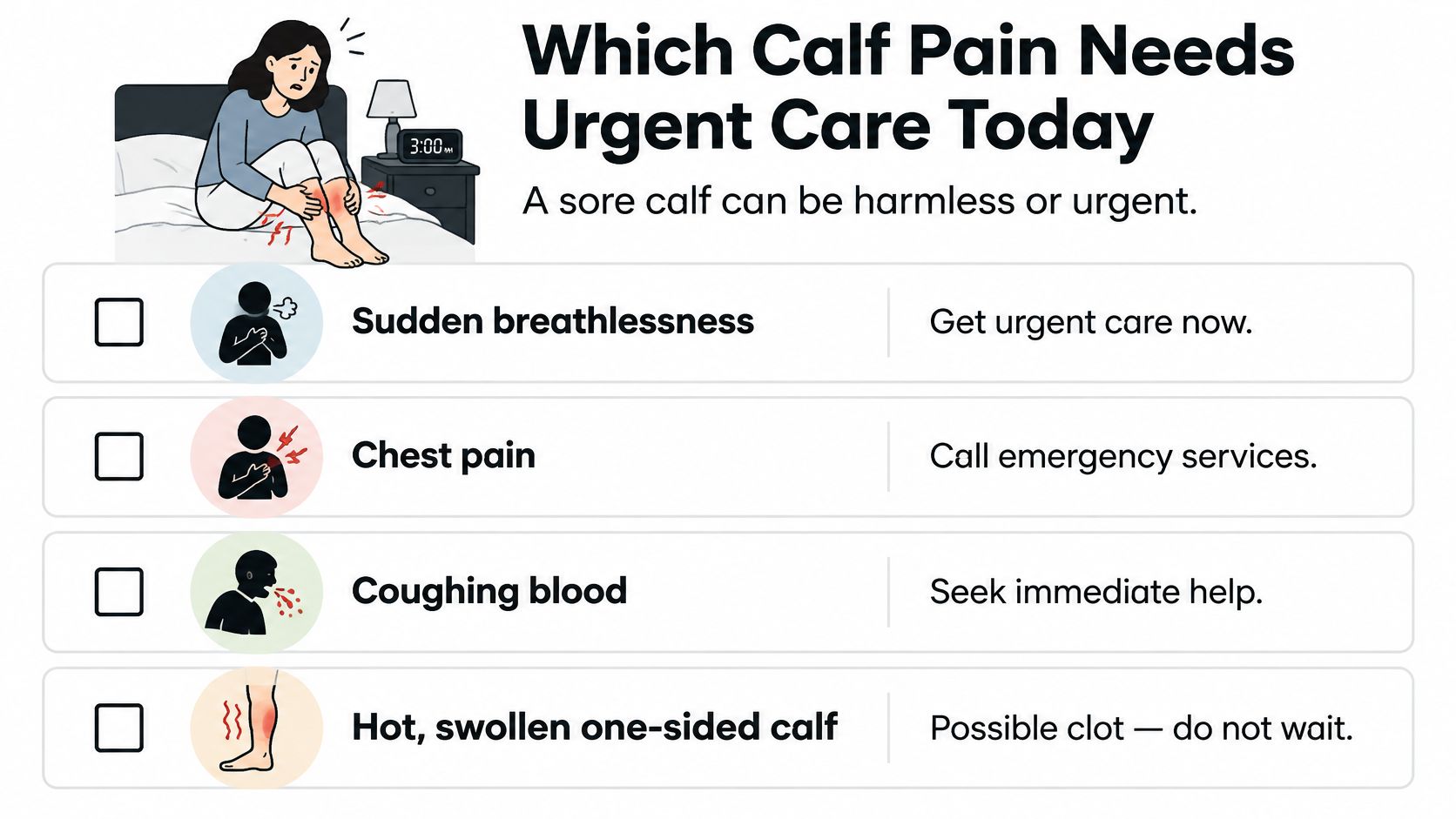
Start with the symptoms that change what you should do, rather than trying to name the condition yourself.
Calf pain patterns and the action each one calls for
| Symptom pattern | What it may point to | Action |
|---|---|---|
| Breathlessness, chest pain on breathing, coughing blood or fainting with calf pain | Possible pulmonary embolism | Call emergency services now |
| Pale, cold or numb foot with sudden severe calf pain | Possible arterial blockage | Emergency department now |
| One leg swollen, warm, red or tender, with surgery, casting, cancer or prolonged immobility | Possible deep-vein thrombosis | Same-day medical assessment |
| Sudden kick or pop in the calf or heel, unable to rise onto the toes | Possible calf or Achilles tendon rupture | Assessment the same day |
| Mild ache after unfamiliar exercise, both legs, no swelling, improving | Likely muscle soreness or mild strain | Home care; arrange review if improvement stalls |
| Calf pain with no clear cause, mild, one side, getting worse | Could be a clot despite mild symptoms | Same-day medical assessment |
Why a mild ache can still need assessment
Pain isn't a reliable measure of whether a blood clot is present. Alberta's public-health guidance on deep-vein thrombosis explains that a clot may cause only minor symptoms, or none, and discomfort may appear only with touch, standing or walking.
That means being able to walk doesn't clear you of a clot. Neither does the absence of dramatic swelling. An unexplained ache in a single calf deserves more attention when it is progressing or follows a period of reduced mobility.
Practical rule: Choose the action level from the whole symptom pattern, not from a pain score.
The visual checklist highlights symptoms that shouldn't be left to home treatment.
Questions to ask before deciding to wait
- One side or both? Unexplained symptoms confined to a single leg need closer attention than symmetrical post-exercise soreness.
- Does the leg look or feel different? Check for new swelling, warmth or redness without repeatedly squeezing the calf.
- Are there clot risk factors? Recent surgery, a cast, cancer or prolonged inactivity should lower your threshold for calling.
In Canada, call 911 for emergencies. For same-day advice when you're unsure where to go, contact a clinician or your provincial 811 health line, where available. If symptoms extend beyond the calf, our guide to when to worry about leg pain can help you describe the broader pattern, but don't delay urgent care to keep reading.
Common Causes of Calf Pain Compared
Muscles, nerves, veins and arteries can all cause calf discomfort, so timing and triggers are often more useful than the location alone.
Non-injury causes of calf pain and their key clues
| Cause | Typical feel | Key clue |
|---|---|---|
| Muscle cramp | Sudden, intense, brief, often at night | Settles as the muscle relaxes, sometimes with gentle stretching and walking |
| Delayed-onset muscle soreness | Dull ache and stiffness after unfamiliar or heavy exercise | Often affects both legs and improves with gentle movement |
| Baker's cyst | Tightness behind the knee spreading into the calf | Swelling behind the knee, which can mimic a clot |
| Chronic exertional compartment syndrome | Tightness, burning or numbness during exercise | Repeatedly eases after stopping exercise |
| Sciatica or nerve irritation | Shooting or burning pain with tingling | May travel from the back or buttock and worsen with sitting |
| Peripheral artery disease | Cramping with walking that eases with rest | Cold foot or weak pulses; smoking and diabetes increase concern |
| Superficial thrombophlebitis | Tender, firm cord under the skin | A painful visible vein that still needs assessment |
Cramp, soreness or something else
A cramp feels like the muscle has suddenly knotted. Once it releases, the intense pain usually settles, although some tenderness can remain. Exercise-related soreness is different: you might notice stiffness after an unfamiliar hill walk, particularly when first getting up from a chair.
Persistent tightness isn't automatically a reason to stretch harder. Our explanation of muscle tightness in the calves discusses how activity demands and muscle capacity can contribute. New swelling or an unexplained change in a single leg needs assessment rather than a flexibility programme.
A Baker's cyst can produce pressure behind the knee, and a leaking cyst may cause calf swelling. You can't reliably separate that from a clot by pressing on the area. Similarly, a tender superficial vein shouldn't be dismissed just because you can see it through the skin.
Activity-related pain needs context
Say your calf cramps at a repeatable point during a walk and improves when you stop. That's different from soreness after a particular workout and warrants a circulation assessment, especially if your foot feels cold.
Exercise-related compartment symptoms also tend to follow a repeatable activity pattern. However, severe, persistent pain with a tense swollen leg, numbness or weakness isn't a routine exercise complaint and needs emergency assessment.
Before an appointment, write down when it started, what brought it on, and what eases it. Those details help a clinician distinguish muscle, nerve and circulation problems without relying on your best guess.
Deep Vein Thrombosis and Why One-Sided Calf Pain Needs Checking
In Canada, DVT affects an estimated 45,000 people each year, according to Thrombosis Canada's DVT diagnosis guide. A DVT is a blood clot inside a deep vein, where it can interfere with blood returning from the leg.
The concern is not just that the calf is sore. It's that unexplained symptoms may reflect a problem inside a vein rather than damage to a muscle.
What clinicians look for
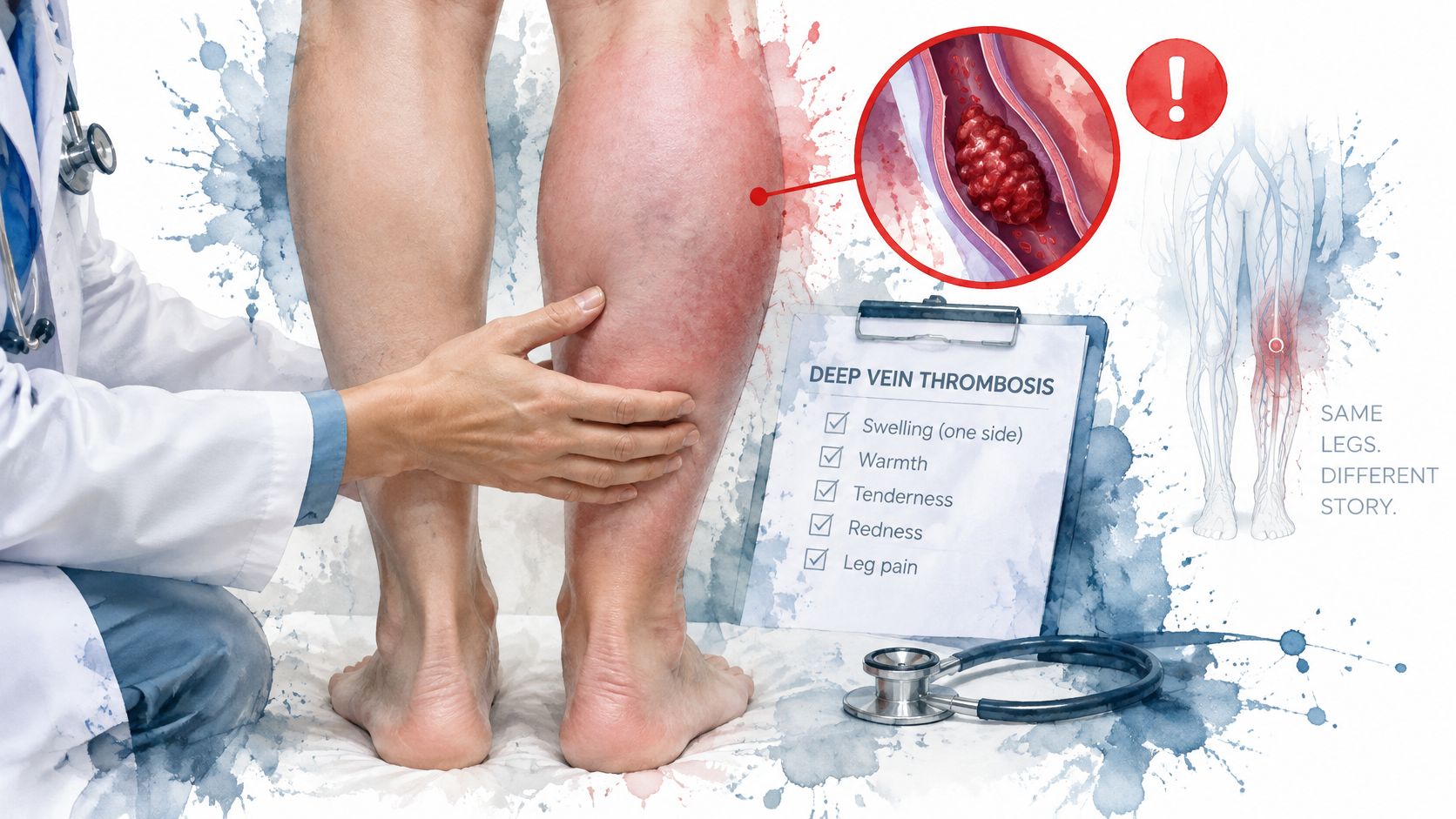
A clinician compares the legs and checks the distribution of swelling and tenderness. They may look for pitting oedema, where pressure leaves an indentation, and newly prominent superficial veins that can develop when normal venous flow is obstructed.
They also ask whether another diagnosis explains the symptoms better. A recent workout is relevant, but it doesn't automatically establish a strain, particularly when the visible changes don't fit the activity.
The examination includes more than locating the sore spot.
Risk factors that change the assessment
Tell the clinician about circumstances that may slow blood flow, affect clotting or injure a vein:
- Reduced mobility: Paralysis, casting, bed rest, or extended sitting during air travel or long car journeys.
- Recent treatment or illness: Major surgery and active cancer are important details.
- Hormonal changes or medicines: Pregnancy, the postpartum period and oestrogen-containing medicines can affect risk. Name any other hormone medicines too.
- Previous clots: A personal history of DVT or pulmonary embolism matters even if the current discomfort feels different.
For people whose symptoms follow desk work or travel, understanding leg pain from sitting too long can help clarify the history. Don't assume sitting-related pain is harmless just because there wasn't an injury.
How a suspected clot is investigated
Clinicians may use the Wells score to organise examination findings and risk factors into probability bands. Even a clinician-assigned low-probability result isn't the same as ruling out DVT.
Wells score probability bands for DVT
| Wells band | Estimated DVT probability | What it means for the reader |
|---|---|---|
| Low | Lower clinical probability, not an exclusion | Clinician decides on further objective testing; don't self-score |
| Moderate | Intermediate clinical probability | Clinician-led assessment and objective testing, usually compression ultrasound |
| High | Higher clinical probability | Prompt objective testing, not treatment as routine soreness |
Compression ultrasound is commonly used to investigate a suspected clot. A D-dimer blood test can help in selected circumstances, but it isn't a stand-alone answer for everyone.
Avoid massage, aggressive stretching or exercising through a suspected clot while arranging assessment. If you're seeking specialist information, Vein and Wound Institute offers a resource to help you find care for suspected DVT; use a local same-day medical service rather than waiting for a distant appointment.
Signs a Clot Has Reached the Lungs
Call 911 immediately if calf symptoms occur with sudden unexplained breathlessness, chest pain on breathing, coughing blood or fainting. Don't drive yourself.
A clot that forms in a leg or pelvic vein can break away and travel to the lungs. This is called a pulmonary embolism, and it can interfere with oxygen exchange and put dangerous strain on the heart.
Symptoms that need emergency help
The warning pattern can include:
- Breathing changes: Sudden shortness of breath or unusually rapid breathing, even without exertion.
- Chest symptoms: Pain that worsens with a deep breath, or a racing or irregular heartbeat.
- Bleeding or collapse: Coughing blood, fainting or feeling close to passing out.
- Signs of serious illness: Marked weakness, confusion or signs of low oxygen, such as bluish lips.
Low oxygen, low blood pressure and collapse can indicate a particularly serious effect on circulation. You don't need to identify those changes yourself before calling.
Thrombosis Canada's pulmonary embolism guidance notes that up to 10% of symptomatic PE cases may be fatal within the first hour of symptoms. This is why sudden breathing or chest symptoms need emergency care rather than observation at home.
What to do while help is coming
- Make the call first: Tell the dispatcher about the breathing, chest or fainting symptoms and follow their instructions.
- Stay somewhere safe: Stop exertion and don't attempt to walk or drive to care.
- Leave topical products aside: Applying pain relief won't treat the cause and shouldn't delay help.
- Give responders the history: Mention the leg symptoms, recent surgery, travel, immobility and any medicines you're taking.
You don't need proof of a clot to call emergency services. The symptoms are enough to justify urgent assessment.
A leg clot can also exist without breathing or chest symptoms. Their absence doesn't establish that a calf problem is muscular or safe to self-treat.
Calf Strains, Tears and Achilles Ruptures
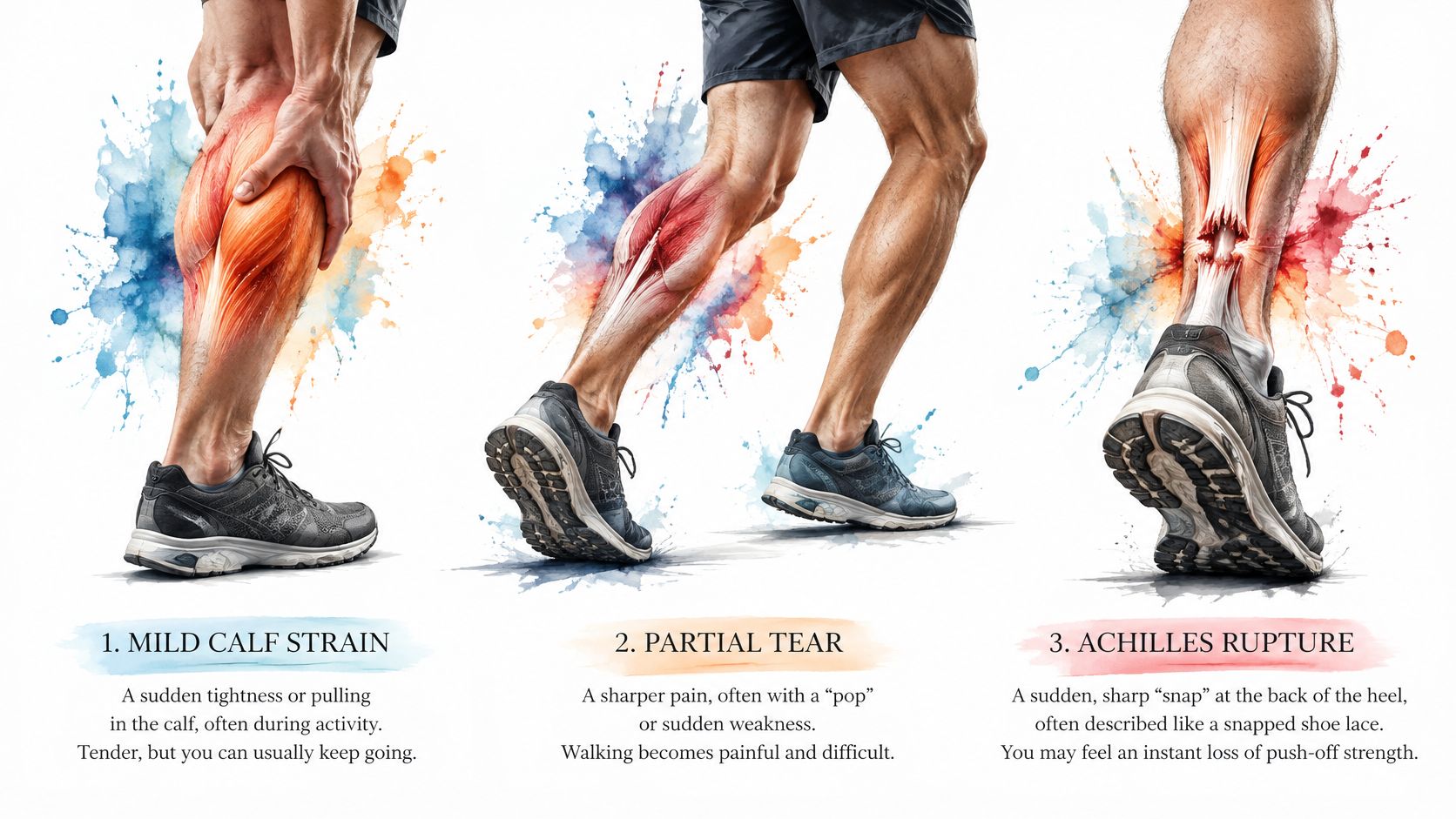
A calf that tightens during a run tells a different story from a sudden bang followed by loss of push-off strength. The onset helps a clinician judge which tissues may be injured, but overlapping symptoms mean it can't establish the diagnosis on its own.
The illustration shows how muscle injuries differ from an injury to the Achilles tendon, which connects the calf to the heel.
Calf and tendon injuries by feel, recovery and urgency
| Injury | How it feels | Approximate recovery | When to see a clinician |
|---|---|---|---|
| Mild calf strain | Tightness, pain on pushing off | Progress according to walking comfort and strength | If improvement stalls or function worsens |
| Moderate calf strain | Sudden pain, bruising, limp | Needs a graded rehabilitation plan | Prompt assessment, especially with difficulty bearing weight |
| Calf tear, sometimes called tennis leg | Sharp pain, feels struck or kicked, bruising towards the ankle | Guided by tear severity and restored function | Same-day assessment |
| Achilles tendon rupture | Bang or kick, possible tendon gap, inability to rise onto toes | Requires a treatment-specific rehabilitation programme | Same-day assessment |
| Tibial stress fracture | Localised shin pain that worsens with running | Requires unloading and clinician-guided return to impact | Prompt review, sooner with rest or night pain |
Why weakness matters
A calf strain involves injury to muscle fibres. More substantial tears can cause bruising and difficulty walking, while tennis leg commonly describes an injury to the inner part of the gastrocnemius muscle.
An Achilles rupture can feel surprisingly similar at the moment it happens. Some people can still walk afterwards, so walking ability alone doesn't exclude it. Treatment may involve immobilisation or surgery, depending on the individual assessment.
If you're already noticing that you can't rise onto the toes, tell the clinician. Don't repeatedly test the leg, force a heel raise through pain or attempt hopping after a pop. A clinician can assess tendon continuity and strength more safely.
The accompanying video provides additional visual context for calf assessment.
Don't use a calendar as clearance
Recovery depends on the tissue involved, the extent of injury and the demands you're returning to. Comfortable everyday walking doesn't demonstrate readiness for sprinting, jumping or sudden changes of direction.
Our guide to a torn muscle versus a pulled muscle explains the terminology. More useful than the label is a clear plan for rebuilding strength and deciding when impact activity is appropriate.
Home Care and When to Book a Visit
Home care is appropriate only when a clot has been considered and is unlikely, and the symptoms fit a minor muscle problem. If that remains uncertain, get clinical advice before starting massage, compression or an exercise programme.
Settle symptoms without completely avoiding movement
Reduce activities that cause a limp or sharp pain. Raise the leg when resting, and use a cold pack wrapped in a cloth for comfort, checking the skin and removing it if it becomes painful or numb.
Avoid heavy massage over a fresh injury. Don't put on a compression sleeve to manage unexplained swelling before a suspected clot has been assessed.
The sequence below gives a simple overview, but your symptoms and diagnosis should guide progression rather than a fixed timetable.
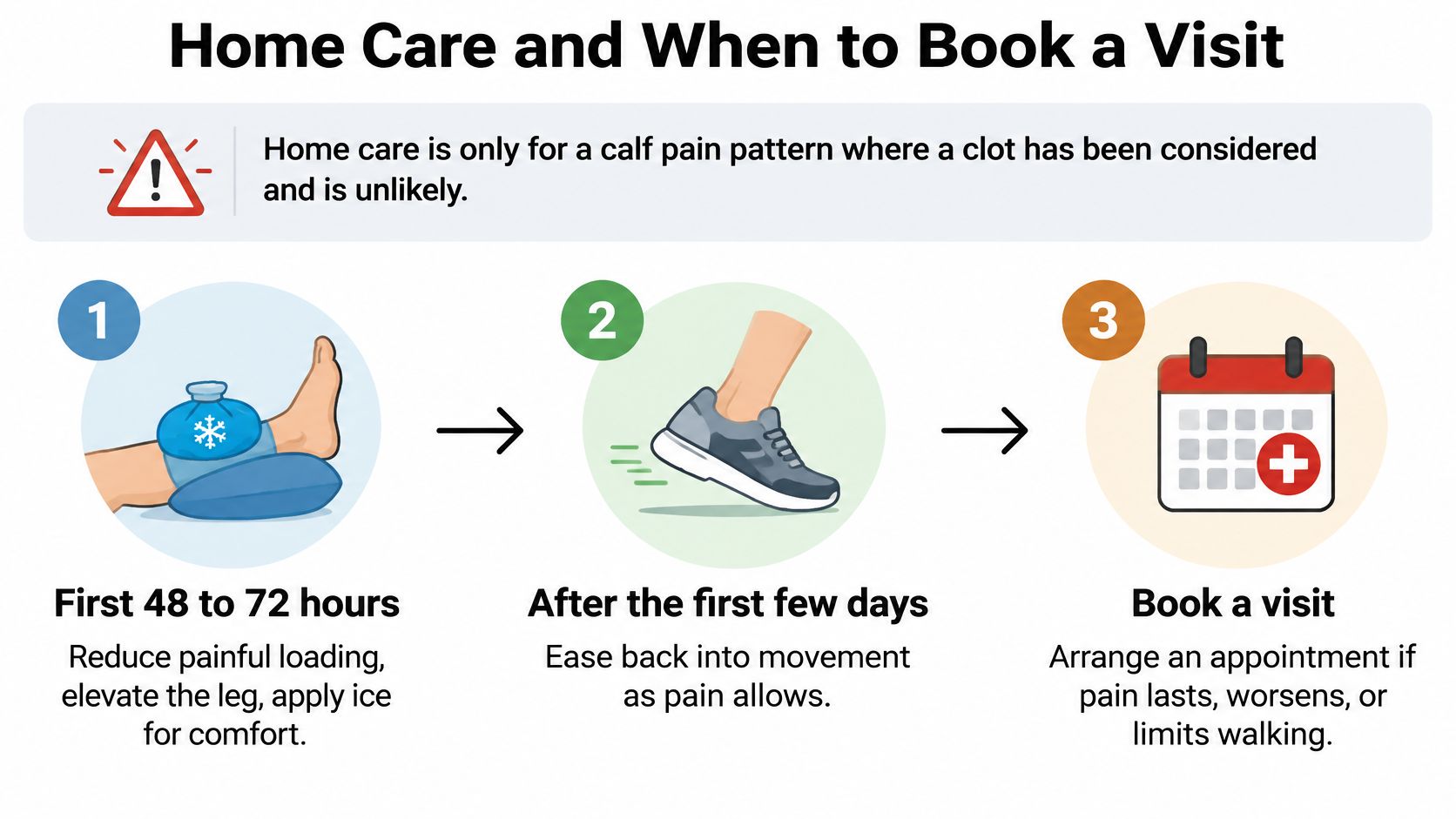
For a likely strain, walk as tolerated rather than forcing a normal distance through pain. Gentle stretching may be suitable once it feels comfortable, but it shouldn't produce sharp discomfort. Our guide to heat or cold for a muscle strain explains how to choose comfort measures without confusing symptom relief with healing.
Build capacity before returning to sport
Start strengthening at a level the calf can manage, such as seated heel raises, then progress towards standing heel raises and greater resistance as advised. Increase the challenge gradually rather than adding speed, weight and distance together.
Lakeridge Health's calf muscle injury guidance recommends walking as tolerated, gradual activity progression, and returning to sport only when you can squat, jump and run without pain. It also advises reducing activity if pain or swelling significantly increases.
- Pain during running: Stop the run and step back to a tolerable activity level.
- More swelling after activity: Reduce the load and seek reassessment if this continues or worsens.
- Pain with braking: Don't drive unless you can control the vehicle and perform an emergency stop safely.
- Declining function: Increasing difficulty walking or new weakness needs review, not more pain relief.
Less pain after a treatment doesn't prove that the muscle or tendon is ready for a heavier load.
Use topical relief within its limits
Our non-prescription MEDISTIK Power Stick and Power Spray provide temporary soothing relief of sore muscles and joints associated with strains and sprains. They don't replace assessment and shouldn't be used to self-treat a suspected clot.
Don't use our products if you're allergic to salicylates or taking anticoagulant medicines, and don't apply them to wounds, broken or damaged skin. Consult a health care practitioner before use if you're pregnant or breastfeeding; don't bandage the treated area or combine use with external heat.
If you experience pain, swelling or blistering, stop use and get medical help right away. Stop and consult a physician if a rash or irritation develops, the condition worsens, or symptoms persist for more than 7 days.
Make the appointment useful
Arrange a visit when improvement stalls, pain keeps returning or walking remains limited. Escalating symptoms or a new red flag call for earlier assessment, not waiting out a home-care trial.
Bring the onset date, preceding activity, changes in swelling or warmth, and relevant surgery, travel, immobility or cancer history. Include all medicines, particularly blood thinners and hormone medicines, plus any topical products you've used.
Ask which diagnosis is most likely, whether testing is needed, and what activities are safe now. Leave with a progression plan and clear reasons to seek reassessment.
MEDISTIK offers non-prescription topical options for temporary relief of sore muscles and joints associated with strains and sprains, once urgent causes of calf pain have been addressed. Visit MEDISTIK to explore our topical formats and pain-management resources, with assessment and graded rehabilitation remaining the foundation of safe recovery.


