

You've finished a workout, carried a heavy bag, or spent the day at a desk, and now one shoulder, calf, or section of your lower back feels tight and tender. You want relief in that exact spot, without necessarily taking an oral painkiller that affects your whole body. That's where a muscle pain relief ointment can fit into a practical routine for temporary comfort.
Topical products aren't magic repairs for torn tissue, nerve compression, or a serious joint injury. They work mainly at the application site, often by changing the sensations your skin and nerves send to the brain. The right choice depends less on a familiar ingredient name and more on matching the product's mechanism, strength, and format to your type of discomfort.

When Sore Muscles Need Targeted Relief
After an intense training session, a runner may notice a dull ache across the thighs later that evening. A warehouse worker may develop a stiff back after repeated lifting, while an office worker may feel a smaller, sharper area of tension near the neck after sleeping awkwardly. These situations are different, but they share an important feature: the discomfort is localised enough to identify.
A topical can be appealing because you apply it to the area you can point to. You can massage an ointment into a sore shoulder, use a gel over a tender knee, or carry a stick for use after activity. This direct routine can feel more manageable than taking a medicine for a pain that exists in only one small region.
The first useful distinction is between symptom control and tissue repair. A topical may reduce the intensity of an ache or make movement more comfortable, but it doesn't automatically correct poor technique, excessive training load, an untreated sprain, or an underlying medical condition. If you're unsure whether the discomfort comes from muscle or joint tissue, this guide on joint pain versus muscle pain can help you think through the difference.
Practical rule: Use topical relief to support comfortable movement, not to silence a warning that gets worse when you continue loading the area.
A simple prime, perform, and restore routine can put an ointment in context. Before activity, some people prefer a warming sensation alongside a proper warm-up. During a demanding day, a portable format can help with a local flare-up. Afterwards, cooling or soothing sensations may make rest and gentle movement more tolerable.
The questions that matter are straightforward. What is causing the pain? Which mechanism suits it? How quickly do you want to feel an effect? What format can you apply safely? You also need to know when topical relief is reasonable and when persistent, severe, or unexplained pain deserves assessment.
How Muscle Pain Relief Ointments Work on Your Body
A topical product starts at the skin, not in the bloodstream. Its active ingredients interact with receptors and tissues near the application site, creating a local sensation or influencing local pain and inflammatory signalling. The result is usually more like turning down the volume on a speaker than repairing the damaged wire inside it.
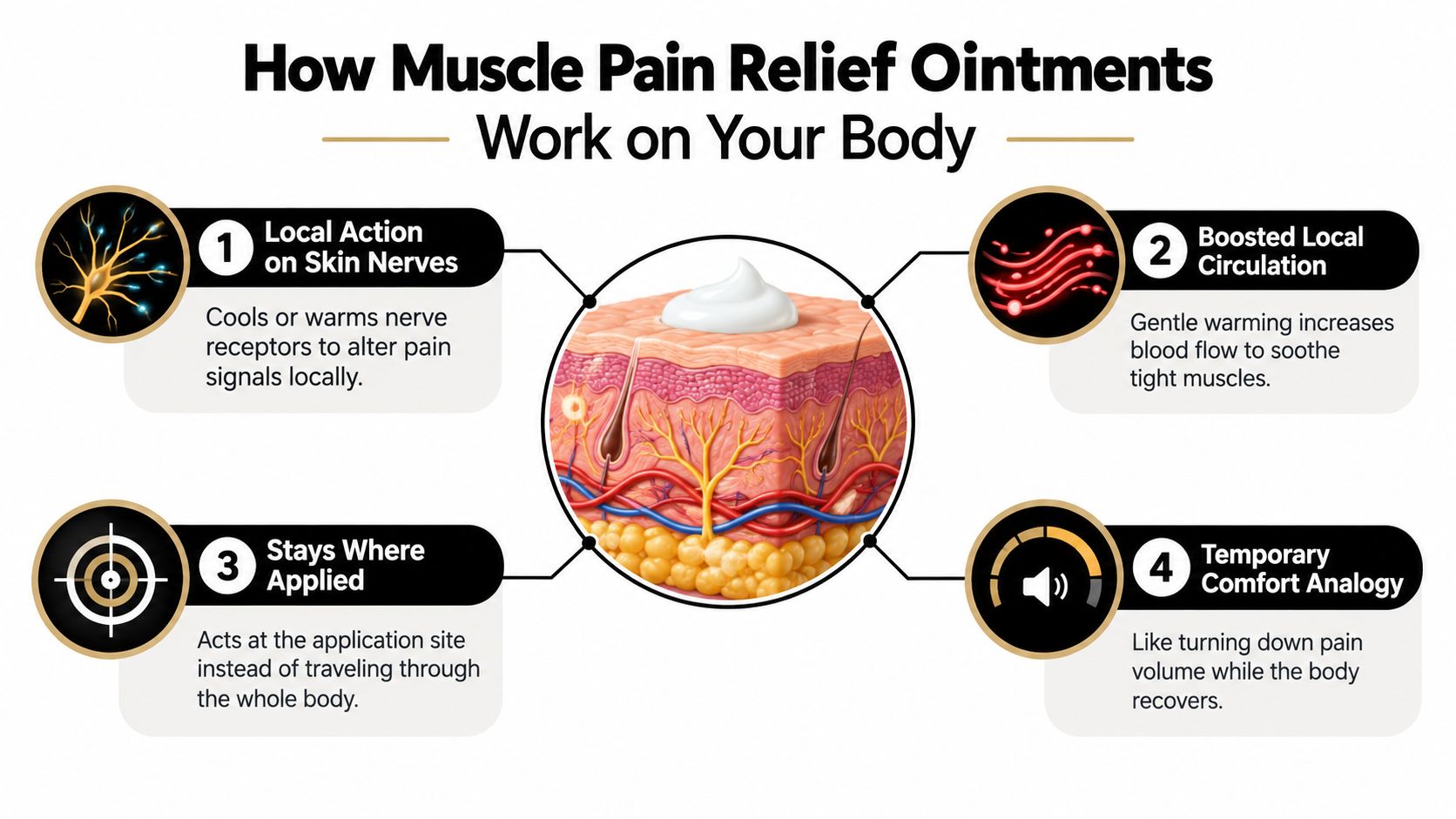
The skin acts as the first control panel
Many familiar topicals are counterirritants. They create a noticeable cooling, tingling, or warming sensation that competes with the discomfort already coming from the sore area. Your nervous system receives several signals at once, and the new surface sensation can make the original ache feel less prominent.
This is often described through the gate control theory of pain. The analogy is useful, provided you don't take it as an exact description. There isn't a physical door that a cream opens and closes, but competing sensory input can influence how strongly pain is experienced.
Menthol commonly produces cooling, while methyl salicylate may create warmth. Capsaicin has a distinctive heat response that can become less intense with appropriate repeated use. These sensations don't prove that the ointment has reached a deep injury, and a strong burn isn't evidence of better treatment.
Local warmth can change how an area feels
A warming product may increase the sensation of heat at the skin and influence local circulation. That can feel soothing around stiffness, particularly when the area responds well to gentle movement and a broader warm-up. It doesn't mean the ointment has restored a strained tendon or corrected a mechanical problem.
Cooling products offer a different experience. The cold sensation can be helpful after activity when the main issue is surface discomfort or post-exercise soreness. Again, comfort can make light movement and recovery habits easier, but it shouldn't encourage you to push through worsening pain.
Relief has a boundary
The product remains most relevant where you apply it. That makes a topical useful for a specific calf, forearm, shoulder, or joint area, but less suitable as a substitute for evaluating widespread pain or symptoms such as weakness, numbness, significant swelling, or loss of function.
The best mental model is temporary symptom relief with a local delivery method. You're adjusting the sensory experience while the body recovers and while you address the cause through rest, load management, rehabilitation, or clinical care when needed.
Common Active Ingredients and What They Do
Ingredient labels become easier to interpret when you group them by mechanism rather than memorising brand names. In Canada, Health Canada states that over-the-counter topical pain relievers are authorised for use on the skin to relieve muscle or joint pain. It also identifies over 400 products available in Canada containing menthol, methyl salicylate, or capsaicin, alone or in combination, as described in this Canadian topical pain cream market overview.
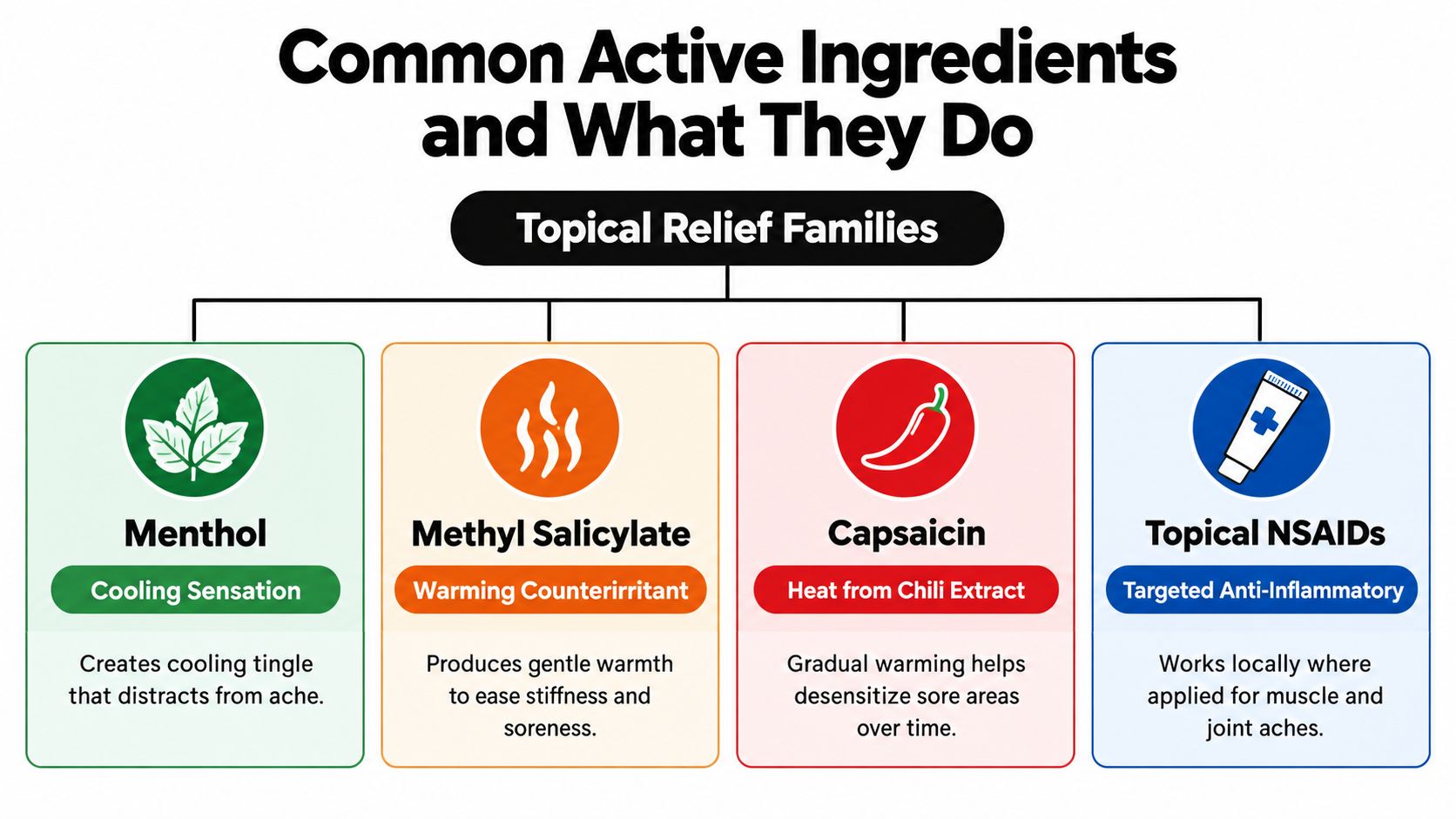
Menthol for a crisp cooling signal
Menthol activates cold-sensitive receptors in the skin. You'll usually notice a cooling tingle fairly quickly, which can distract from a fresh ache or post-workout soreness. It can suit someone who dislikes heat or wants a refreshing sensation after activity.
Cooling doesn't necessarily mean anti-inflammatory treatment, and a cold feeling doesn't tell you how serious an injury is. If swelling, bruising, or restricted movement is substantial, assess the injury rather than relying on the sensation alone. For a plain-language discussion of menthol products, see how menthol works in topical pain relief.
Methyl salicylate for warming counterirritation
Methyl salicylate, sometimes called oil of wintergreen, produces a warming counterirritant effect. People often choose this sensation for stiffness, a tight back, or an ache that feels better after gentle activity.
Warmth can be pleasant, but it can also become intense if you apply too much, cover the area tightly, or add an external heat source. Follow the label instead of judging the amount by how strong the warmth feels.
Capsaicin for gradual desensitisation
Capsaicin comes from chilli peppers and produces heat by acting on sensory nerve receptors. Its role differs from a quick cooling product. With suitable repeated use, it can reduce the ability of certain pain pathways to signal as strongly, although the initial heat or burning sensation may be uncomfortable.
Capsaicin requires careful adherence to directions. It isn't a natural licence to apply more frequently, and it shouldn't be used on damaged or irritated skin.
Topical NSAIDs for inflammatory pain
Topical non-steroidal anti-inflammatory drugs, or NSAIDs, are a separate family. Rather than relying mainly on a cooling or warming distraction, they act locally on inflammatory processes. They may be relevant when inflammation contributes to a local sprain, strain, or arthritic joint complaint.
These categories can overlap in a single formula, so read the active ingredient panel and warnings. The sensation tells you what you feel, but the ingredient and authorised use tell you what the product is designed to do.
Ointment vs Cream vs Gel vs Spray and Stick
The base determines how a topical fits into your day. An ointment tends to feel richer and may remain on the skin longer, while a gel often dries more quickly. A spray can cover an awkward or hard-to-reach area without requiring much rubbing, and a stick offers controlled, no-mess application.
That choice matters in real situations. A clinic may value precise coverage and easy hand hygiene. An athlete may prefer something that fits in a kit and won't leak. Someone applying a product before bed may tolerate a richer texture better than a worker who needs to dress immediately.
| Format | Feel and Absorption | Best For |
|---|---|---|
| Ointment | Rich, moisturising, and slower to disappear from the skin | Focused application when residue isn't a concern |
| Cream | Balanced texture with moderate spreadability | General home or clinic use |
| Gel | Lighter feel and usually quicker drying | Post-activity use or people who dislike greasy products |
| Spray | Minimal contact and broad, convenient coverage | Hard-to-reach areas and on-the-go application |
| Stick | Precise, portable, and hands-free | Work, sport, travel, and small targeted areas |
A thicker ointment may feel more substantial, but that doesn't mean it penetrates farther or provides stronger relief. The active ingredient, concentration, directions, and your skin's response matter more than texture alone.
For a practical example of a traditional rub format, you can browse Radian B Muscle Rub. Treat any product page as a starting point for checking the active ingredients, intended use, warnings, and application directions, not as a substitute for reading the label.
Application insight: The easiest format to use correctly is often the one that fits your routine without encouraging excessive reapplication.
A spray may be convenient for the middle of a workday, but you still need to protect your eyes, avoid inhaling the product, and cover only the intended area. A stick can improve precision, while a cream may be easier to spread over a broad muscle. This overview of topical pain relief product formats offers further context when you're comparing delivery options.
What Clinical Evidence Says About Benefits and Limits
Health Canada's counterirritant monograph describes these products as intended for temporary relief of muscle and joint aches and pains associated with simple backache, strains, sprains, and arthritis. That authorisation supports use in settings such as physiotherapy, sports recovery, and occupational pain management, but it doesn't promise that every formulation will suit every condition.

What “works” should mean
A useful result may be modest. You might be able to climb stairs more comfortably, complete gentle rehabilitation exercises, or sleep without focusing constantly on a local ache. That can be valuable, even when the topical hasn't changed the underlying cause.
Evidence for topical NSAIDs includes testing in acute sprains and strains and in osteoarthritis. The Canadian health technology evidence summarised through the Health Canada counterirritant monograph reports that, in chronic musculoskeletal pain, about 10% more people achieved good relief than with placebo. The same evidence base indicates that local skin reactions still occur in a notable minority.
Why benefits vary
A small, localised ache may respond differently from deep, widespread, or nerve-related pain. A product designed for temporary counterirritation may make a tight muscle feel more comfortable, while a topical NSAID may be a more logical discussion for a local inflammatory joint problem, depending on the product and your health history.
Clinical testing also has limits. A product tested for mild to moderate muscle strain shouldn't automatically be treated as a solution for unexplained back pain, severe trauma, or symptoms that spread beyond the original area.
Relief is useful when it helps you move wisely. It becomes risky when it encourages you to ignore a worsening injury.
Combine topical comfort with appropriate rest, gradual activity, strengthening, and professional guidance where needed. Seek assessment when pain persists, returns repeatedly, follows significant trauma, or comes with neurological symptoms, marked swelling, fever, or major loss of function.
Safe Use Side Effects and Who Should Be Cautious
A muscle pain relief ointment should be treated like a medicine, even when it feels like a simple rub. The safest routine is controlled, label-led, and conservative. More product doesn't create proportionally more relief, but it can increase skin exposure and irritation.
A careful application routine
- Check the skin first. Apply only to clean, intact skin. Avoid cuts, abrasions, rashes, eczema flare-ups, and sunburn.
- Use the labelled amount. Spread a thin layer over the intended area rather than repeatedly coating the same spot.
- Keep sensitive areas clear. Don't apply near the eyes, lips, nostrils, or other mucous membranes.
- Wash your hands. Clean them thoroughly after application, especially before touching your face or handling contact lenses.
- Leave the area uncovered unless the label says otherwise. Don't add a tight wrap, compression layer, or heating pad without explicit professional or product guidance.
The reason for the heat warning is specific. Occlusion and external warmth can intensify exposure and trap heat against the skin. Cooling products also deserve caution, because irritation can develop even when the first sensation feels soothing.
Reactions that need attention
Mild redness, itching, tingling, or warmth can occur locally. Stop using the product and seek advice if the reaction is painful, persistent, blistered, spreading, or accompanied by swelling or breathing difficulty.
Health Canada's safety review identified 29 unique Canadian reports of serious skin burns associated with over-the-counter topical pain relievers containing menthol, methyl salicylate, or capsaicin, including reports involving use as directed, as detailed in this Canadian safety review record. The history is important because it shows why label directions and heat precautions aren't optional.
People with very sensitive skin, a known salicylate or aspirin allergy, pregnancy, chronic medical conditions, or regular medication use should ask a pharmacist or clinician before choosing a product. Children and older adults may also need product-specific guidance, particularly when applying over larger areas.
How to Choose the Right Muscle Pain Relief Ointment for You
Start with the pain, not the marketing claim. Ask whether the problem feels like a fresh, localised soreness, stiffness that eases with movement, a recurring inflammatory joint complaint, or something unfamiliar that needs assessment.
Then match the mechanism:
- Choose a cooling profile if a crisp surface sensation feels comfortable after activity.
- Choose warming counterirritation if stiffness responds well to gentle movement and you can avoid added heat.
- Consider capsaicin carefully when gradual nerve desensitisation is the intended approach and you can follow repeated-use directions.
- Discuss a topical NSAID with a pharmacist or clinician when local inflammation, a sprain, strain, or osteoarthritis is central to the complaint.
Format should follow your setting. An ointment may suit focused home use, while a gel, spray, or stick may be easier at work, in a clinic, or around training. Read the Canadian label for active ingredients, directions, warnings, age guidance, and any Health Canada authorisation information.
If you want a broader product comparison before deciding, review this guide to the best muscle pain relief cream options, then compare the actual label rather than choosing by sensation alone. Use the product as part of a sensible recovery plan, and get professional help when pain persists, worsens, or doesn't match a straightforward muscle strain.
MEDISTIK offers Canadian-made topical options for temporary relief of sore muscles and joints, including an extra-strength stick, fast-acting spray, and cooling roll-on for different application preferences. Visit MEDISTIK to compare formats and choose a topical routine that fits work, sport, clinic care, or everyday recovery.


