

You've finished a long desk session, or you've just put a heavy barbell back in the rack, and one area is complaining. Your upper trapezius feels knotted, your mid-back is stiff, or your lower back has that familiar post-training ache. Reaching for a muscle pain relief rub feels sensible, but the useful question isn't whether rubbing something on the area feels good. It's whether the product matches the problem, the timing, and the rest of your recovery plan.
A topical rub can be useful for localized, non-neuropathic muscle or joint pain when the skin is intact. It can temporarily change how pain feels, support movement, and make light massage more comfortable. It won't repair a torn tendon, correct a nerve problem, or replace sleep, adequate food, sensible loading, and clinical assessment. Canadian guidance also distinguishes authorized topical medicines from compounded products, so the label and regulatory status matter as much as the sensation.
When a Muscle Pain Relief Rub Becomes the Right Next Move
Consider two common situations. A remote worker stands after several hours at a laptop and feels a dull ache across the mid-back. An experienced lifter finishes rows and overhead presses with a tight upper trapezius but no weakness, numbness, swelling, or loss of movement. In both cases, a rub may be reasonable, but only after a quick check of the pain pattern and the skin.
A muscle pain relief rub fits best when the discomfort is local, mechanical, and familiar. The area should have intact skin, and the symptoms should behave like ordinary soreness, tightness, a mild strain, or a minor sprain. If gentle movement improves the feeling, the pain stays in one region, and there are no alarming symptoms, a topical product can sit alongside mobility work, heat or cold, and reduced training load. A useful comparison of topical and oral options is available in this discussion of topical pain relievers versus oral pain relievers.
Clinical rule: Use the rub to make sensible recovery easier, not to make a serious injury easier to ignore.
Canadian arthritis guidance lists topical diclofenac and topical capsaicin as reasonable alternatives for osteoarthritis pain, particularly when acetaminophen hasn't provided enough relief or oral medicines aren't well tolerated. The same guidance describes topical agents as tools for symptomatic relief rather than long-term disease control, which is why a rub belongs inside a plan rather than at the centre of one. Arthritis Society Canada's medication guidance is a useful reference for people managing recurring joint symptoms.
The rest of the decision comes down to three practical questions. What does the active ingredient do? When are you applying it around training? And does the product have an authorized Canadian label that supports the way you intend to use it? Those answers matter more than whether the packaging promises a dramatic hot or cold sensation.
How Muscle Rubs Work on Sore Tissue
A strong hot or cold sensation does not prove that a rub is treating the source of pain. Many products act mainly on superficial sensory nerves, changing how the nervous system registers discomfort from deeper muscle or joint tissue.
Health Canada classifies products containing menthol, methyl salicylate, or capsaicin as counterirritants. They create mild irritation at the skin's surface, producing a competing signal that can reduce the prominence of an ache. The effect is local and temporary. It does not repair a strained muscle, restore damaged tissue, or correct the cause of an injury. Skin safety also matters. Health Canada's safety review of pain relievers containing menthol, methyl salicylate, and capsaicin highlights the need to use these products according to their labels.
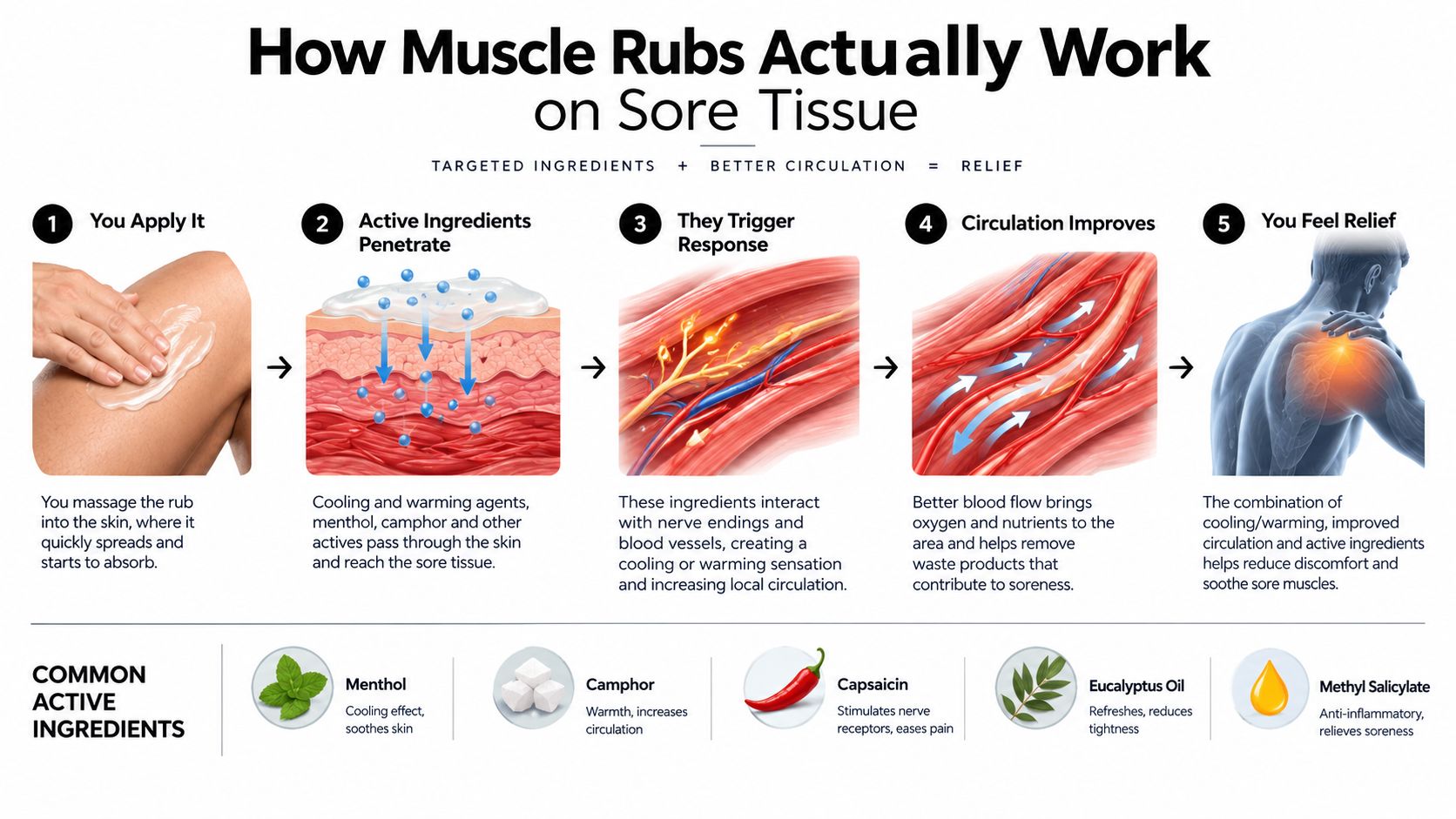
Three mechanisms that matter
Counterirritants compete with the pain signal. Menthol feels cool, while methyl salicylate often feels warm. That new sensory input can temporarily change the signal reaching the brain, similar to firm pressure around a sore area. The rub may make light movement more comfortable without changing the underlying tissue.
Topical NSAIDs target pain and inflammation differently. Diclofenac is a topical non-steroidal anti-inflammatory drug, not just a warming or cooling cream. Its evidence base also differs from that of a compounded formula. Canadian evidence summaries report that topical NSAIDs can relieve pain similarly to oral NSAIDs for chronic osteoarthritis and acute musculoskeletal pain. Research from Unity Health Toronto considers them safer than opioids in knee osteoarthritis. The Canadian Medical Association Journal review adds useful context, but products are not interchangeable. Use an authorized Canadian product for its labeled indication and duration.
Capsaicin works through repeated exposure. It can cause heat or burning at first, then reduce the sensitivity of pain-sensing nerve endings with continued application. That makes it more suited to persistent, localized symptoms than to occasional post-workout soreness. Follow the label and stop if the reaction is intolerable.
Read why soreness happens and how to ease alongside the product instructions. Recovery still depends on appropriate training load, sleep, movement, and assessment when symptoms persist. For a practical comparison of product categories, use this guide to topical pain medications.
The decision rule is simple: judge a rub by its active ingredient, intended use, safety directions, and duration of relief, not by the intensity of its sensation.
Common Active Ingredients and What Each One Feels Like
Start with the active ingredient, not the sensation. Menthol, capsaicin, methyl salicylate, and diclofenac serve different purposes, and an authorized Canadian product should be used only for its labeled indication and duration.
| Active Ingredient | Sensation | Best-Used Scenario | Notes |
|---|---|---|---|
| Menthol | Cooling, fresh, sometimes brisk | Short-term relief for exercise soreness or superficial muscular ache | A counterirritant that changes pain perception at the skin |
| Methyl salicylate | Warming, aromatic, penetrating-feeling | Localized muscular tightness and sore areas that respond well to warmth | Follow the label carefully, especially when combined with other salicylates |
| Capsaicin | Hot, burning, then gradually less noticeable | Persistent localized pain and some chronic osteoarthritis symptoms | Repeated use matters, and initial discomfort is common |
| Topical NSAIDs such as diclofenac | Usually little dramatic sensation | Inflammation-driven joint, tendon-adjacent, or perimuscular pain | Use only for the authorized indication and duration on the Canadian label |
Match the feeling to the job
Menthol is the practical first choice for many active adults. It absorbs or dries relatively quickly and provides immediate cooling feedback. That suits post-training soreness when there is no obvious swelling or concern about structural injury. For a clear explanation of its sensory effect, read this guide to menthol in cream. Use it as one recovery tool, alongside appropriate training load, sleep, movement, and monitoring.
Methyl salicylate feels warmer and more substantial. That warmth may feel useful over a tight back or shoulder before gentle mobility, but it does not prove that the product reaches deep muscle or treats inflammation. Follow the label, and do not casually combine it with other salicylate-containing products.
Capsaicin requires commitment. Burning or heat is common at first, and repeated application may be needed before the area becomes less sensitive. Choose it for a persistent, well-defined symptom pattern, not unexplained new pain or occasional post-workout soreness. Stop if the reaction becomes intolerable.
Topical diclofenac is a treatment category, not a generic muscle rub. It is a topical NSAID with specific evidence and authorized indications. Canadian labeling differs by formulation, indication, and duration, so check the product's Canadian label rather than assuming every diclofenac preparation has the same status.
A DIN or NPN, clear directions, and a suitable active ingredient matter more than an intense sensation or bold marketing claim. Compounded topicals belong to a separate category. They are not automatically stronger, safer, or interchangeable with an authorized Canadian product. Use the rub to support a broader recovery plan, not to judge tissue readiness by how hot or cold the skin feels.
Using a Rub Around Training and Competition
A rub should support your training sequence, not disguise pain so you can keep forcing the same movement. Use the prime, perform, restore framework, and keep the application modest.
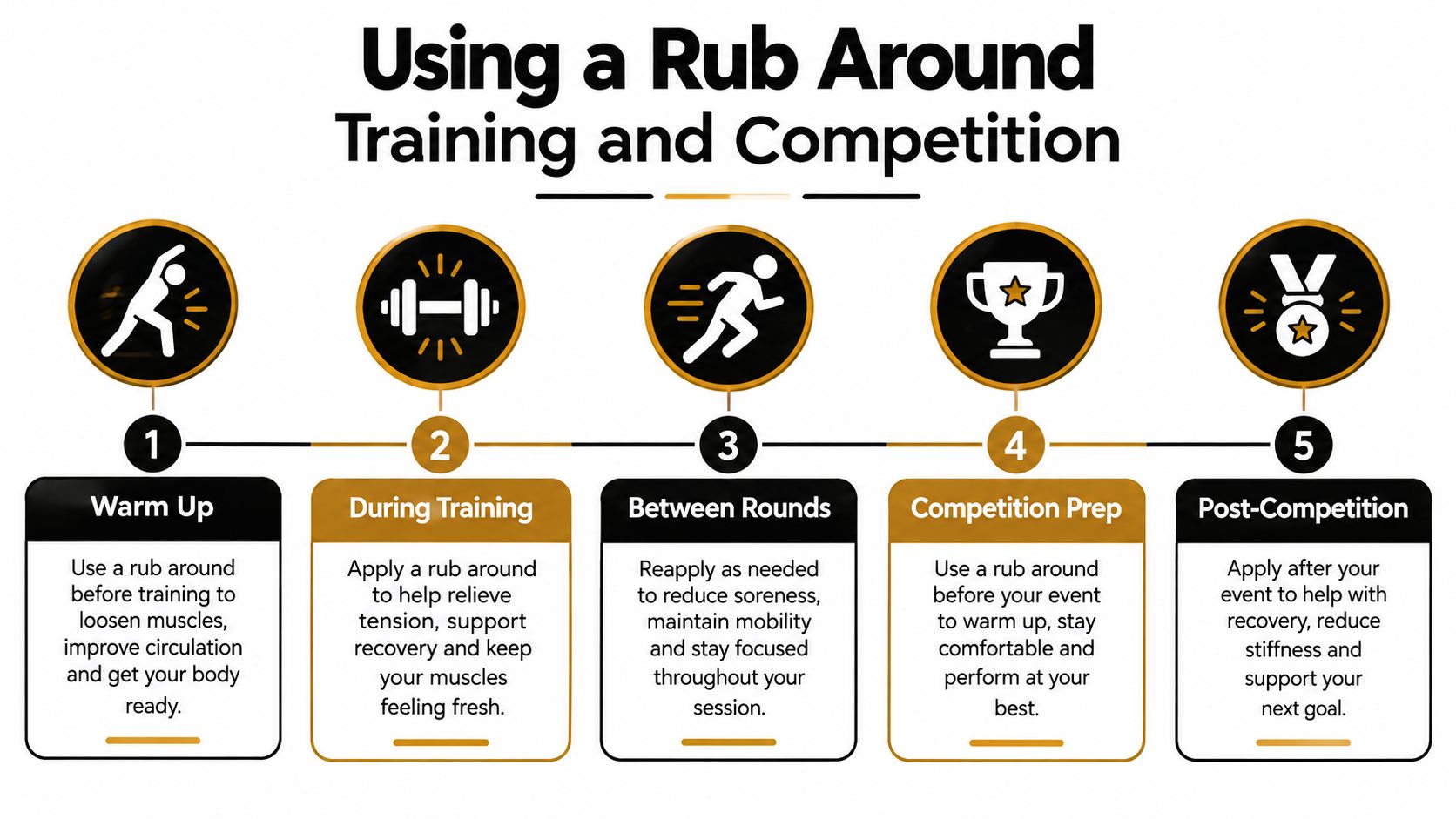
Prime
Before the warm-up, apply a thin layer of a low-intensity menthol or warming counterirritant to the target region if you already know you tolerate it. Give the product time to settle before putting on tight sleeves, wraps, or protective equipment. The goal is sensory preparation and comfortable movement, not replacing a progressive warm-up.
Perform
Heavy applications during activity are a poor strategy. Sweat and friction can increase irritation, and clothing, tape, sleeves, or wraps can trap the product against the skin. A strong sensation can also distract you from a movement pattern that needs attention.
A topical product can reduce the alarm signal. It can't tell you whether the tissue is ready for another maximal effort.
Restore
The post-training period is where a rub usually makes the most sense. After cooling down, use a thin layer over the symptomatic muscle and combine it with easy range-of-motion work, relaxed breathing, and a light self-massage. A spray format can be practical when hand contact is inconvenient, while a cream or stick may be better for controlled application. Sports-focused pain-relief spray guidance can help clinicians and athletes compare application formats.
Use this simple protocol:
- Prime: Apply a light layer to the selected area before the warm-up, then move through your normal mobility and rehearsal drills.
- Perform: Don't repeatedly reapply under sweat, clothing, wraps, or equipment. Stop if the skin starts to sting, burn, or itch.
- Restore: Apply after the cool-down, massage gently, and reassess how the area moves rather than chasing a stronger sensation.
The rub won't compensate for poor sleep, inadequate hydration, under-fuelling, or a training load that keeps exceeding recovery capacity. Those inputs determine whether temporary relief helps you return to normal or merely postpones the same complaint.
Choosing a Product With Confidence
Choose from the label outward. A product should pass three filters: safety, potency, and formulation. Price comes later, because an inexpensive product that doesn't match the symptom, or irritates the skin, isn't a useful bargain.
Canada's arthritis burden gives this category practical importance. The Pharmacy Association of Nova Scotia states that osteoarthritis affects 1 in 10 adults in Canada and rheumatoid arthritis affects 1 in 100 adults, with osteoarthritis most common among people over 60 and approximately twice as common in women as in men. Its arthritis information supports a simple conclusion: many households need a dependable approach to recurring localized pain, not just an impulsive purchase after a bad workout.
The three-filter check
Safety: Look for a Canadian DIN or NPN where applicable, read the warnings, and check fragrances, preservatives, and botanical ingredients against known sensitivities. Don't apply any product to broken, irritated, or infected skin. Treat compounded products cautiously, because authorization, labelling, and evidence aren't automatically equivalent.
Potency: Mild soreness may respond to a single counterirritant. More persistent joint-adjacent symptoms may justify a discussion with a pharmacist or clinician about a topical NSAID. Don't choose a product solely because it creates the most heat or cold.
Formulation: Gels tend to suit daytime use because they dry quickly. Creams work well over larger areas and during self-massage. Roll-ons and sticks reduce hand exposure and make application more practical at work, in a clinic, or beside the training floor.
| Criterion | What to Check | Why It Matters |
|---|---|---|
| Safety | DIN or NPN information, warnings, skin compatibility | Confirms that you understand the product's authorized use and risks |
| Potency | Active ingredient and concentration on the label | Connects the formula to the pain pattern and intended sensation |
| Formulation | Gel, cream, spray, roll-on, or stick | Determines how cleanly and precisely you can apply it |
| Use case | Directions for muscle, joint, strain, sprain, or arthritis symptoms | Prevents casual substitution between products with different indications |
If you're comparing a botanical or herbal option for bruises, aches, or strains, review the product details in this guide to an herbal rub for bruise recovery, then check its Canadian labelling and active ingredients rather than relying on the word “natural”.
What a Rub Cannot Fix and When to Escalate
A rub changes symptoms. It doesn't mend a tendon, stabilise a joint, resolve nerve compression, treat systemic inflammation, or correct pain caused by poor sleep and under-fuelling. If you need increasingly strong applications to complete ordinary tasks, the product is no longer serving as recovery support. It's masking a problem that deserves assessment.
The authorized-versus-compounded distinction also matters. The Workplace Safety and Insurance Board states that compounded topical analgesics aren't approved by Health Canada and don't have an official indication. That doesn't mean every compounded preparation is useless, but it does mean you shouldn't treat it as interchangeable with a product reviewed and labelled through the Canadian authorization pathway.
Stop experimenting and arrange an assessment when
- The pain persists beyond roughly a week or two despite sensible load reduction and basic self-care.
- Swelling, redness, or warmth worsens, especially when the area becomes increasingly tender.
- Numbness, tingling, or weakness appears, or pain travels down an arm or leg.
- Fever, unexplained weight loss, or feeling systemically unwell accompanies the pain.
- Pain wakes you repeatedly, particularly when changing position doesn't ease it.
- Trauma preceded the symptoms, or you can't bear weight or use the limb normally.
A clinician may need to examine strength, reflexes, joint stability, range of motion, and the pain's distribution. Another layer of topical analgesic can't provide that information. For athletes, prevention also includes sensible technique, appropriate equipment, and load progression. A practical resource on injury prevention equipment is relevant when the same activity repeatedly provokes symptoms.
Think of the rub as one input among training load, sleep, nutrition, movement, and clinical care. It can be useful, but only when those surrounding decisions make sense.
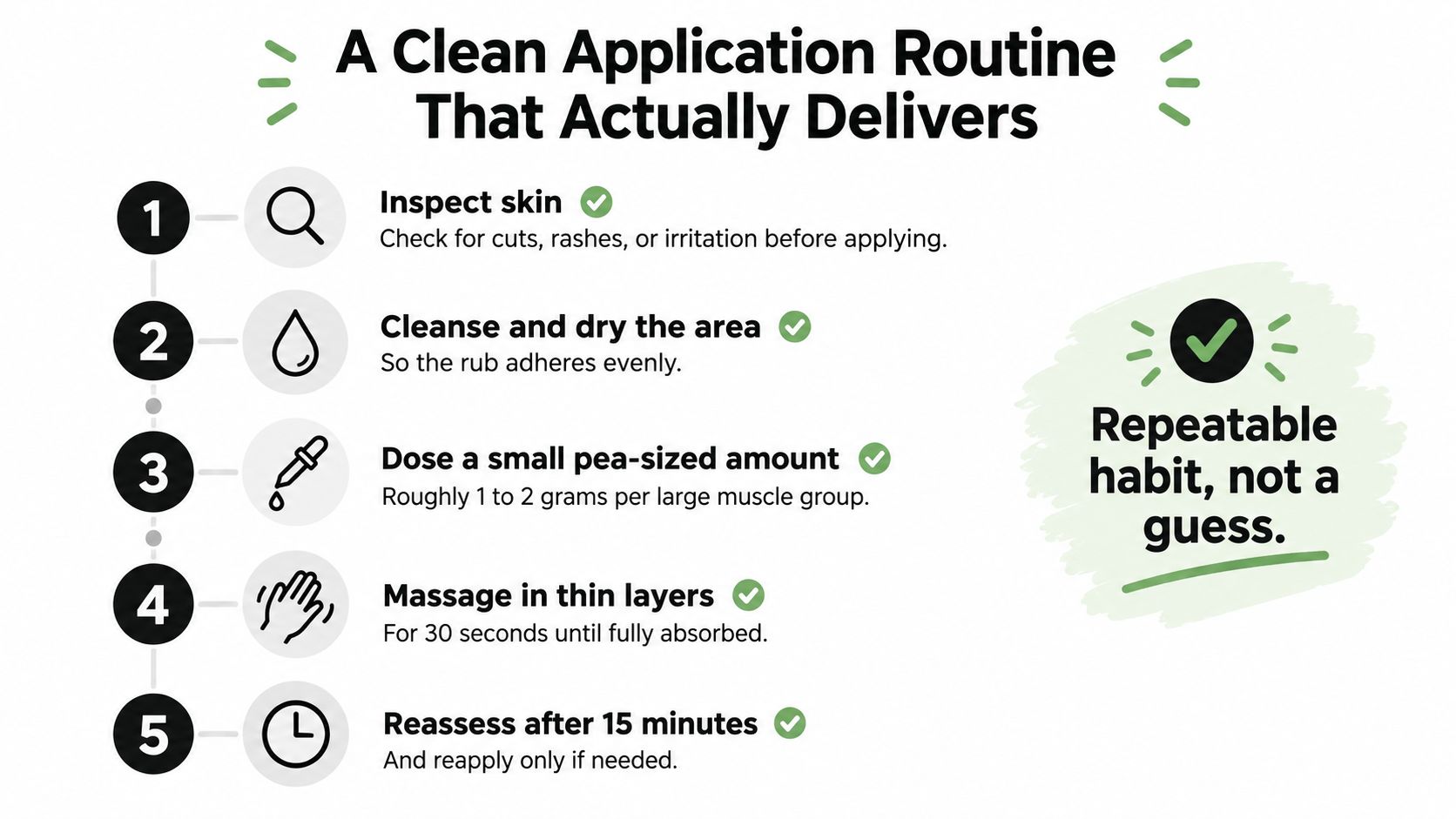
A Clean Application Routine That Delivers
A good muscle rub routine starts before the product touches your skin. Apply too much, use it over irritated skin, trap it under tight clothing, or add heat, and you increase irritation without improving recovery. Use the same controlled sequence each time.
Follow the same sequence each time
- Inspect the area. Check for cuts, rashes, sunburn, broken skin, or an existing reaction. Do not apply the rub to abnormal skin.
- Clean and dry. Remove sweat, oils, and other creams. Dry skin allows more even application.
- Patch test unfamiliar products. Use a small amount on a limited area first, particularly with capsaicin, fragrance, botanical extracts, or several counterirritants.
- Use a thin layer. Start with a small amount, roughly a pea-sized portion for a large muscle group, unless the label gives different directions. More product means more skin exposure, not proportionally more relief.
- Massage gently. Spread the rub evenly without pressing hard on acutely sore tissue. Stop if burning, blistering, marked redness, or worsening pain develops.
- Wash your hands. Keep the product away from your eyes, mouth, mucous membranes, and contact lenses. Do not touch your face immediately afterward.
- Avoid casual occlusion. Do not cover treated skin with a tight wrap, heating pad, or heavily insulated clothing unless a health professional and the product directions specifically support it.
- Reassess before reapplying. Compare pain, tenderness, and range of motion later that day and over the next couple of days. Stop if symptoms worsen or change character.

Do not combine topical products on the same area to intensify the sensation. Heat, ice, massage, and another analgesic may each have a role, but layering them without checking labels can increase irritation or hide a worsening symptom. For a diclofenac product, follow its authorized Canadian directions rather than copying a schedule intended for menthol cream.
For spray-specific instructions, review this guide on how to use pain relief spray. The same standards apply: intact skin, controlled dosing, clean hands, and reassessment based on function rather than sensation alone. A rub supports a broader recovery plan. It does not replace sensible training adjustments, sleep, nutrition, movement, or clinical care.
Quick Answers for Buyers and Practitioners
Is a muscle pain relief rub enough on its own? Usually, no. It can temporarily reduce discomfort and make light movement or massage more tolerable, but the underlying plan still needs appropriate load management, mobility, progressive strengthening, sleep, and adequate nutrition. If the same pain returns whenever you resume normal activity, the recurring trigger needs attention.
Which active ingredient should I choose? Start with the symptom and timing. Menthol suits a cooling sensory effect for short-term soreness. Methyl salicylate provides a warming counterirritant experience. Capsaicin is better considered for persistent localized symptoms where repeated use is appropriate. A topical NSAID such as diclofenac is a different category and should be selected according to its authorized indication and label.
Can I use a rub before training? You can use a tolerated product as a sensory aid before a warm-up, but it isn't a substitute for gradually increasing movement intensity. Avoid heavy applications during the session, particularly under sweat, sleeves, tape, or wraps. Post-training use is often easier to control.
What does a rub not fit? Radicular pain, progressive weakness, numbness, significant swelling, fever, unexplained weight loss, persistent night pain, and pain after meaningful trauma should move you toward clinical assessment. A specific pattern of weakness can indicate nerve involvement even when the muscle itself feels sore.
Are compounded topicals equivalent to authorized products? No. WSIB notes that compounded topical analgesics aren't approved by Health Canada and lack an official indication. Ask what the product contains, who prepared it, what evidence supports it, and whether its labelling matches your intended use.
For clinics and active adults, MEDISTIK's topical solutions include a stick, spray, and cooling roll-on designed for temporary relief of sore muscles and joints in practical at-home, clinic, and on-the-go formats. Its product range can fit a prime, perform, and restore routine, but it should still be used as a symptom-management tool rather than a substitute for diagnosis or progressive rehabilitation.
Choose the least complicated product that matches the pain, apply it cleanly, and judge success by improved comfortable movement rather than an intense skin sensation. Escalate when the pattern stops looking like ordinary mechanical soreness.
If you need a practical topical option for training recovery, clinic use, or recurring muscle and joint discomfort, explore the MEDISTIK range of sticks, sprays, and roll-ons. Visit MEDISTIK to compare formats and build a more consistent prime, perform, and restore routine.


