

You wake up after a long run, a hard training session, or a demanding shift and your calf feels as though it has shortened overnight. Walking downstairs is awkward, pushing off the foot hurts, and the instinct is to rub the area hard, stretch until it loosens, or reach for the strongest painkiller available. That reaction is understandable, but the right approach to muscle pain relief in the legs depends on what caused the pain and how the tissue responds over the next few days.
Leg pain is common within the wider pattern of musculoskeletal problems. In Canada, chronic pain affects about 18.9% of adults, while musculoskeletal disorders had a point prevalence as high as 27.8% in 2017, with the back and knee among the most affected areas, according to a Canadian medical review. A sore calf after overuse may settle with sensible self-care, but swelling, fever, a rash, worsening symptoms, or difficulty walking changes the decision entirely.
The practical sequence is simple: protect the irritated area, control symptoms without immobilising yourself, restore comfortable movement, then rebuild strength. Pain relief should support that process, not convince you to load an injured muscle before it's ready.
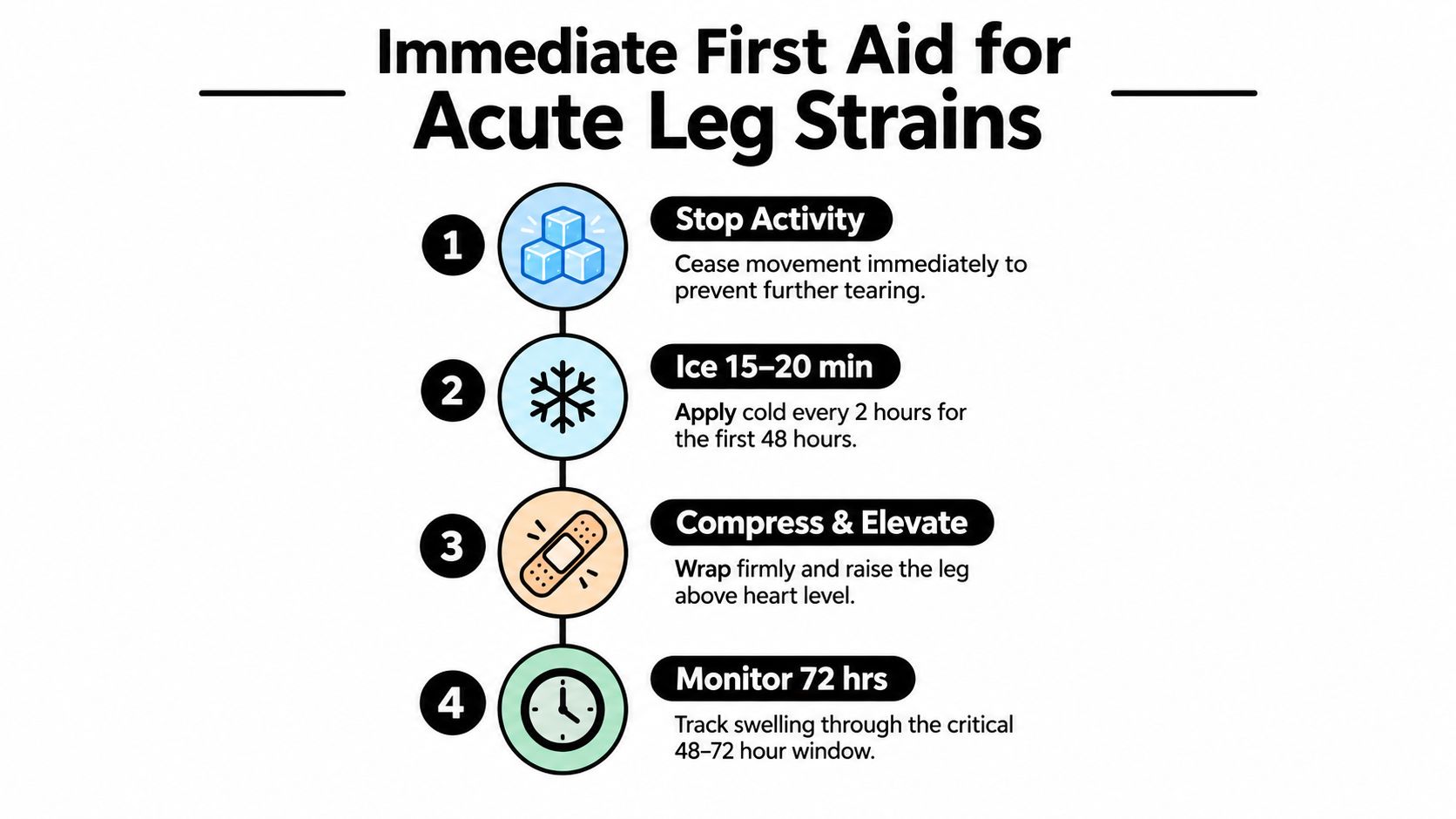
Immediate First Aid for Acute Leg Strains
You finish a brisk walk and feel a sudden tug high in the back of your thigh. At first, it seems manageable. Later that evening, the hamstring feels tight and tender, and by morning you're limping. This is the point at which many people make recovery harder by testing the muscle repeatedly, stretching aggressively, or returning to normal activity because the pain has briefly eased.
During the first 48 to 72 hours, treat a suspected strain as an irritated structure that needs protection, not as a limb that must be placed in complete rest. Stop the activity that caused the pain, reduce unnecessary walking, and use support if it helps you move without limping. You're aiming to prevent further aggravation while keeping safe, easy movement available.
The first day
Cold therapy can reduce discomfort and make a throbbing area easier to tolerate. Wrap an ice pack or frozen gel pack in a cloth and apply it for 15 to 20 minutes, repeating approximately every 2 hours during the first 48 hours if it provides relief. Don't place ice directly on skin, fall asleep with it in place, or use it over numb or damaged skin.
Compression can help limit uncomfortable swelling, but it must remain comfortable. A support wrap should feel firm rather than constricting. Loosen it if the foot becomes cold, pale, unusually numb, or tingly. Raise the leg when you're resting, ideally so it sits above the level of your heart, because this can reduce the sense of pressure and fluid pooling.
Practical rule: If an intervention makes the leg more painful, more numb, or more swollen, stop using it rather than assuming you need to “push through.”
Avoid deep massage, forceful stretching, heat applied to a freshly swollen injury, alcohol, and hard exercise in the early phase. These actions can make it more difficult to judge whether the tissue is settling. Gentle ankle movements, short trips around the home, and changing position regularly are usually more useful than staying completely still.
What to monitor
Check the leg at regular intervals rather than repeatedly provoking the painful movement. Note whether swelling is increasing, whether bruising is spreading, and whether you can bear weight with a normal or nearly normal walking pattern. If symptoms began after unusual exposure to pressure or diving, information about the hyperbaric treatment of DCS is relevant, because that situation isn't the same as a routine sports strain.
For a practical comparison of cold and heat in a muscle strain, see this guide to choosing heat or cold. Once swelling is no longer increasing and ordinary movement is becoming easier, shift away from passive care. The next stage is controlled mobility, not repeated icing for its own sake.
Targeted Topical Treatments and Application
A topical treatment makes the most sense when the pain is localised, easy to identify, and linked to a sprain, strain, or overuse episode. A sore muscle belly in the calf or thigh is a more suitable target than vague, widespread leg discomfort with no clear mechanical trigger. The aim is temporary local relief that allows comfortable movement while the underlying tissue recovers.
Canadian guidance lists topical non-steroidal anti-inflammatory drugs, or NSAIDs, as a first-line option for acute lower-leg pain caused by sprains, strains, and overuse injuries. The best-supported concentrations in the cited British Columbia guideline include diclofenac 1% to 4%, ibuprofen 5% to 10%, and ketoprofen 1% to 5%. Canadian over-the-counter diclofenac products are typically 1.16% or 2.32%, and the guideline describes low systemic absorption from topical NSAIDs, approximately 6% to 23% compared with oral forms, while still advising attention to safety cautions (British Columbia pain guidance).
Match the product to the problem
Topical NSAIDs have the clearest role in an acute, localised musculoskeletal injury. Canadian evidence summaries from Dalhousie report that topical NSAIDs improve pain and physical function in acute musculoskeletal injuries, and describe diclofenac emulgel producing at least 50% pain reduction over one week versus placebo, with an NNT of 2 (Dalhousie acute pain evidence summary). Those findings don't mean every type of leg pain needs an anti-inflammatory gel. They support a short, consistent trial when the pain pattern fits.
A cooling roll-on may feel better for a hot, tired, or mildly irritated area after activity. An extra-strength stick or spray can be more convenient when you need targeted application to a calf, thigh, foot, or another hard-to-reach area. MEDISTIK offers a Canadian-made topical range that includes an extra-strength stick, an extra-strength spray, and a natural ice roll-on for temporary relief of sore muscles and joints. Treat any topical as one part of a recovery plan, not as permission to sprint, jump, or train through sharp pain.
Apply it deliberately
- Inspect and clean the skin. Apply only to intact skin. Avoid cuts, rashes, infected areas, and recently shaved or irritated skin, and wash your hands afterwards unless your hands are the treatment area.
- Use a thin, even layer. Follow the product label for the amount and frequency. For topical diclofenac, the British Columbia guidance describes application three to four times daily for up to seven days, with continued use only in people who respond and periodic reassessment.
- Don't cover it tightly. Occlusive dressings, heating pads, and additional products can alter skin exposure and increase irritation. Check the label, especially if you take oral NSAIDs, have medication allergies, or have a history of stomach, kidney, heart, or bleeding problems.
- Move after the pain settles. Walk slowly, perform easy ankle pumps, or practise a comfortable knee bend. If relief allows normal movement but disappears when you increase the load, the muscle still needs rehabilitation.
For a fuller explanation of how topical pain medicines fit into self-care, use this topical pain medication overview. Stop the product if you develop a rash, marked burning, breathing difficulty, or other concerning reaction, and ask a pharmacist or clinician about interactions before combining topical and oral medication.
Restoring Mobility Through Strategic Stretching
Stretching is useful only when the tissue can tolerate the movement. A calf that has just been strained doesn't need to be pulled into a deep wall stretch, and a hamstring that hurts during walking shouldn't be tested with a long seated reach. Early recovery should restore motion without asking the muscle to absorb a large tensile load.
Start with comfortable range
During the early phase, move frequently but stay below sharp pain. Try slow ankle circles, ankle pumps, heel slides, and easy knee bends while lying or sitting. For a calf strain, a short, flat walk is appropriate only if you can avoid limping. For a hamstring or quadriceps strain, gently bend and straighten the knee without forcing the end position.
The sensation should be mild pulling, stiffness, or awareness of the injured area. Sharp pain, a sudden grab, increasing soreness later that day, or more swelling the following morning means the dose was too high.
Progress in phases
Calves: Begin with ankle pumps and controlled heel raises using both legs when walking is comfortable. Progress to supported single-leg heel raises, then vary the knee position to challenge both the gastrocnemius and soleus. Keep the movement slow and stop before the heel drops into a painful stretch.
Hamstrings: Start with gentle heel slides and hip movements in a comfortable range. Later, add a light bridge, keeping the pelvis level and avoiding cramping. A mild static stretch can be introduced once ordinary walking and low-load strengthening are comfortable.
Quadriceps: Use heel slides and controlled knee bends first. Progress to sit-to-stand movements and shallow split-stance bends before deeper lunges. Keep the knee tracking in line with the foot rather than allowing it to collapse inward.
Light static holds of 15 to 20 seconds can be appropriate as swelling fades, but they shouldn't be forced. Dynamic stretching and sport-specific drills belong near the return-to-activity stage, when the leg can tolerate repeated loading.
“Never stretch through sharp pain.” A larger range isn't automatically a better range if you're borrowing motion from healing tissue.
Watch the video below for a visual movement reference, but use comfort and control as your guide rather than copying a range that doesn't suit your injury.
If your calves repeatedly feel restricted despite gradual loading, this resource on calf muscle tightness can help you distinguish general stiffness from a problem that deserves assessment. Mobility should make the next movement easier, not leave you more irritable.
Strengthening and Preventing Future Flare-Ups
Pain relief can help you move, but it can't replace capacity. A calf, hamstring, or quadriceps muscle often flares again when the demands placed on it exceed what it can currently tolerate. The answer isn't to avoid all activity. It's to rebuild force, endurance, coordination, and confidence in a gradual order.
The most useful question is not “Which muscle is tight?” but “Which task is asking too much of this muscle?” A weak or poorly coordinated hip can leave the hamstrings doing more work during running and lifting. Limited ankle motion can make the calf compensate during squats, hills, and repeated push-off. Fatigue, sudden changes in training, and skipping a warm-up can expose those limitations.
Build a simple load ladder
Start with exercises you can perform smoothly and without a pain increase that lingers. Use the next day's response as feedback.
- Calf capacity: Begin with double-leg heel raises while holding a counter. Progress to single-leg raises, then add a slow lowering phase. Later, use a step only if the full range remains comfortable.
- Hamstring control: Use bridges with both feet supported, then progress by moving the feet farther away or using a single-leg variation. Add a hip hinge with a neutral spine before returning to fast running or powerful acceleration.
- Quadriceps strength: Sit-to-stand repetitions, shallow squats, and controlled step-ups build practical force. Increase the step height or depth only when the knee and thigh remain aligned and steady.
- Hip support: Side-lying leg lifts, band walks, and single-leg balance help the hip control the position of the pelvis and knee. Good control reduces unnecessary strain elsewhere in the leg, although it doesn't guarantee that an injury won't recur.
Warm up the demand, not just the body
A warm-up should resemble the activity you're about to perform. Walk before jogging, jog before sprinting, and rehearse low-intensity changes of direction before a competitive game. Add a few controlled heel raises, bodyweight squats, marching steps, or hip hinges so the nervous system encounters the positions you'll use under load.
Don't increase distance, speed, hills, or training volume all at once. If you've had repeated issues, record what was different before each flare-up, such as footwear, surface, workload, sleep, or a new drill. Practical injury-prevention advice for grappling and other demanding sports is also available in these Locals Jiu Jitsu Zetland injury tips.
A strong leg isn't one that never feels tired. It's one that can tolerate the forces of work, sport, and daily life without losing control. Progress only when the current level feels repeatable, and keep one or two strengthening sessions in your routine after symptoms settle.
When to Escalate to a Healthcare Professional
The assumption that every sore leg is a minor strain is unsafe. A familiar ache after unfamiliar exercise may improve with movement and time, but pain accompanied by swelling, skin changes, systemic symptoms, neurological symptoms, or loss of function requires a different response.
Canadian self-care guidance recommends medical assessment for leg pain that worsens or occurs with swelling, rash, or fever, as well as pain that doesn't improve. Alberta aftercare advice also flags those symptoms as reasons to seek care rather than continuing home treatment (Alberta leg pain aftercare guidance).
Use function and symptoms as your decision points
Arrange prompt medical assessment if you have:
- Worsening swelling: The leg becomes progressively larger or tighter rather than gradually settling.
- Redness, heat, or fever: These symptoms don't fit ordinary post-exercise soreness and may indicate an infection or another condition needing examination.
- Numbness or tingling: Altered sensation, weakness, or symptoms travelling down the leg need clinical assessment.
- Loss of function: You can't bear weight, walk safely, straighten the knee, or push off the foot.
- Unexplained pain: Pain appears without a clear activity trigger, is severe at rest, or repeatedly wakes you at night.
- A sudden structural change: A loud pop, visible deformity, or immediate major loss of strength may signal more than a small muscle irritation.
Seek emergency help for severe symptoms such as sudden breathing difficulty, chest pain, fainting, or rapidly worsening limb symptoms. Don't massage a swollen, hot, unexplained leg while waiting for advice.
A useful test: A minor strain should show a direction of travel. If the leg isn't becoming easier to use, the diagnosis and plan deserve another look.
Persistent pain also deserves review even when it began during exercise. A physiotherapist can assess strength, range, gait, and loading tolerance, while a physician or sports medicine clinician can investigate conditions that aren't appropriate for self-treatment. Guidance for deciding when to worry about leg pain can help you prepare questions, but it doesn't replace an examination when red flags are present.
Your Daily Leg Recovery and Relief Protocol
A useful recovery plan should fit around work, childcare, training, and sleep. It shouldn't require you to monitor the leg every few minutes or rely on pain relief while ignoring function. Use the schedule below as a flexible template, and reduce the workload if symptoms worsen later the same day or the following morning.
Morning
Start with a few minutes of easy movement before testing the sore area. Perform ankle pumps, knee bends, a gentle march, or a short walk around the home. The goal is to find your comfortable range, not to achieve a deep stretch immediately after waking.
If the leg is still acutely swollen, raise it during breakfast or another quiet period. Use cold for 15 to 20 minutes if it reduces discomfort, keeping a cloth barrier between the cold source and your skin. Don't use a topical product on broken or irritated skin, and follow its label rather than applying repeatedly because the pain remains.
During the day
Break up long periods of sitting with brief, easy movement. At work, use a short walk, controlled heel raises, or gentle knee bends as a reset, provided these don't produce sharp pain or a limp. Choose level ground and a comfortable pace before returning to hills, stairs, running, or cutting movements.
If you're increasing walking distance, keep the pace controlled and pay attention to hydration guidance such as the practical walking pace and hydration advice. Hydration won't correct a strain by itself, but sensible fluid intake supports normal activity, especially during demanding or warm conditions.
Apply a suitable topical treatment only as directed and use the resulting comfort to practise normal movement. Don't treat temporary numbness or reduced pain as proof that the muscle has recovered. A return to sport requires strength and control, not just a quieter symptom.
Evening
Review three things: swelling, walking quality, and how the leg responded to the day. If all three are stable or improving, complete a short mobility routine and a low-load strengthening exercise from the appropriate stage. If the leg is more painful, return to the previous tolerable level rather than adding more stretching.
Raise the leg while reading or watching television if it feels heavy. Sleep in a comfortable position, and avoid placing prolonged direct pressure on a tender muscle. For additional guidance on combining activity, rest, and symptom management, use this muscle recovery after a workout guide.
The lasting solution is a daily rhythm: calm the initial flare, move within tolerance, apply targeted relief when appropriate, and progressively strengthen the tissues that must handle your normal life. If the pattern stops improving or develops any warning sign, replace self-treatment with professional assessment.
MEDISTIK offers Canadian-made topical options, including an extra-strength stick, spray, and natural ice roll-on, for temporary relief of sore muscles and joints during work, sport, and everyday movement. Visit MEDISTIK to explore the formats and educational resources, then choose a product that fits your pain pattern and recovery routine.


